@Slides from Sebastian Giufrida
An authoritative historical and numismatic study by House of Emirates® of a Roman provincial bronze diassarion from Corinth, combining imperial portraiture, Greek mythology, civic identity, and the sacred landscape of the Isthmus.
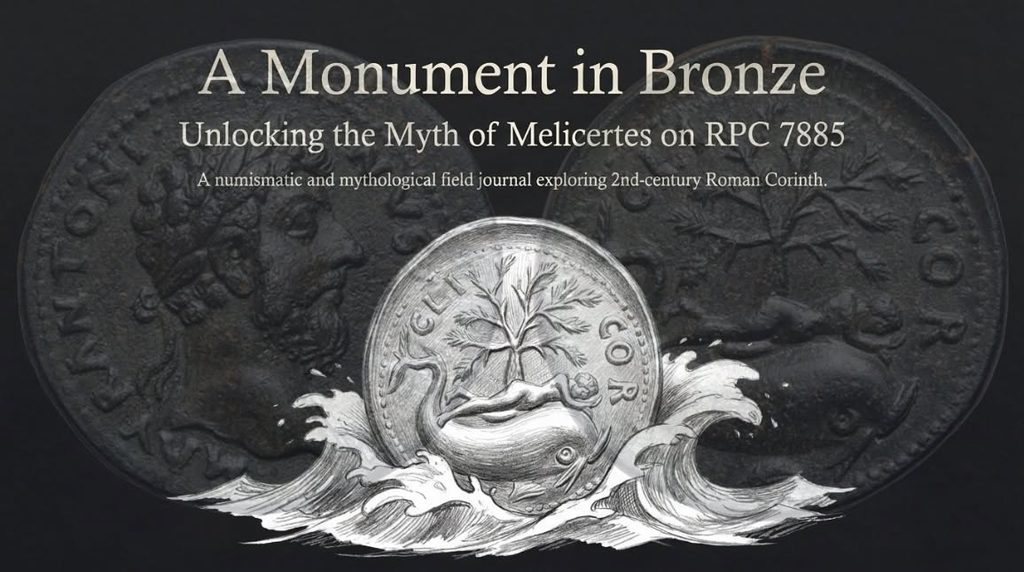
The bronze coin of Corinth bears the laureate portrait of Emperor Marcus Aurelius. It also shows Melicertes-Palaemon reclining upon a dolphin beneath a pine tree. The coin is far more than an instrument of everyday exchange.
It is a miniature historical document. This depiction brings together the political authority of the Roman Empire. It also emphasizes the enduring religious traditions of ancient Greece. Corinth’s distinctive cultural identity. Corinth’s strategic importance shaped how Rome acknowledged its Greek heritage. During the second century AD, Rome asserted sovereignty while Corinth preserved its Greek heritage.
The coin’s two principal designs express complementary dimensions of provincial life. The obverse presents Marcus Aurelius, the Roman emperor whose reign from 161 to 180 AD became associated with Stoic philosophy, imperial responsibility, and the challenges of governing a vast empire. The reverse transports the viewer into the sacred mythology of the Corinthian Isthmus, depicting Melicertes, transformed into the maritime deity Palaemon, carried by a dolphin, with a pine tree rising behind him. Together, these images unite imperial administration and local religious memory in a compact bronze object whose significance extends well beyond its monetary value.
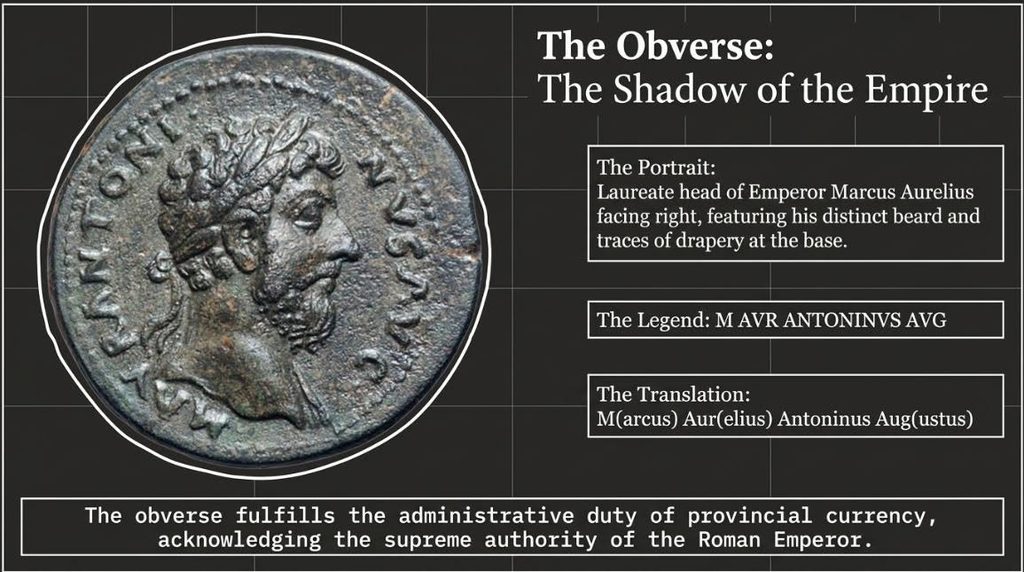
The obverse bears the inscription M AVR ANTONINUS AVG. It is an abbreviated imperial titulature identifying Marcus Aurelius Antoninus Augustus.
His laureate head faces right, presenting the emperor in a traditional visual language of Roman authority.
The laurel wreath, inherited from Greek and Roman traditions of victory and distinction, was a familiar symbol of imperial prestige. The emperor’s portrait established the authority under which the coin circulated.
Marcus Aurelius succeeded Antoninus Pius in 161 AD. He ruled during a demanding period of Roman history.
His reign saw military campaigns along the Danube frontier and pressures on the empire’s borders. The Antonine Plague added to the era’s challenges.
Yet his reputation endures because of his philosophical reflections preserved in Meditations. These writings reveal a ruler concerned with duty, self-discipline, mortality, and the responsibilities imposed by power.
The appearance of Marcus Aurelius on a provincial coin should not be interpreted simply as an act of personal commemoration. Imperial portraits served an essential administrative and political function throughout the Roman world. They communicated the legitimacy of Roman government, connected local transactions to the wider imperial economy, and reinforced the relationship between provincial communities and the emperor.
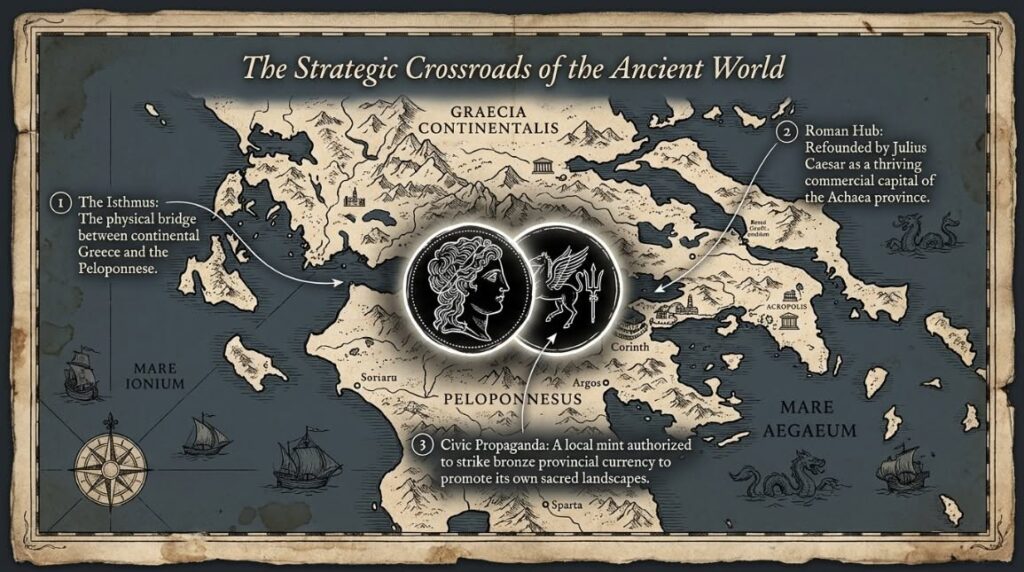
In Corinth, this imperial image acquired particular significance. The city held considerable economic and strategic importance. It sat near the narrow Isthmus that connects mainland Greece with the Peloponnese.
Its commercial networks, maritime connections, and religious traditions made it an important center of Roman provincial life.
By placing Marcus Aurelius on the obverse, Corinth acknowledged imperial sovereignty. It retained the freedom to express its civic identity through the reverse design.
The portrait therefore establishes the political framework of the coin. Rome supplied the overarching authority; Corinth supplied the local cultural meaning.
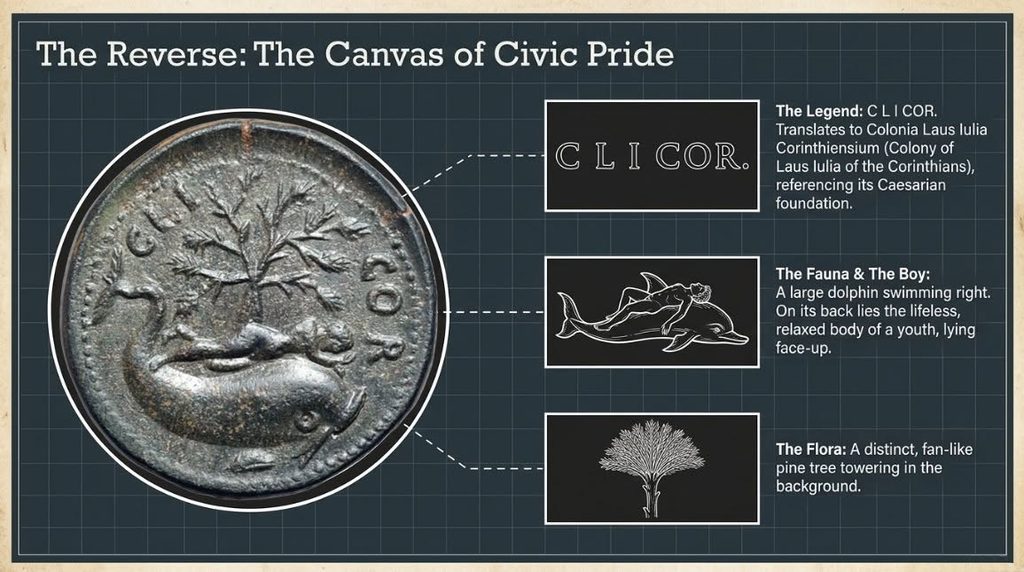
The reverse transforms the coin from a conventional provincial issue into a powerful expression of Corinthian mythology. It depicts Melicertes-Palaemon reclining upon the back of a dolphin swimming to the right, while a pine tree rises behind the figure. The accompanying inscription, C L I COR, identifies the civic authority responsible for the issue. The composition is remarkable for its economy: a child, a dolphin, and a tree evoke an entire mythological narrative and the religious traditions of the Isthmus. The type is documented in the authoritative Roman Provincial Coinage catalog as RPC IV.1 7885.
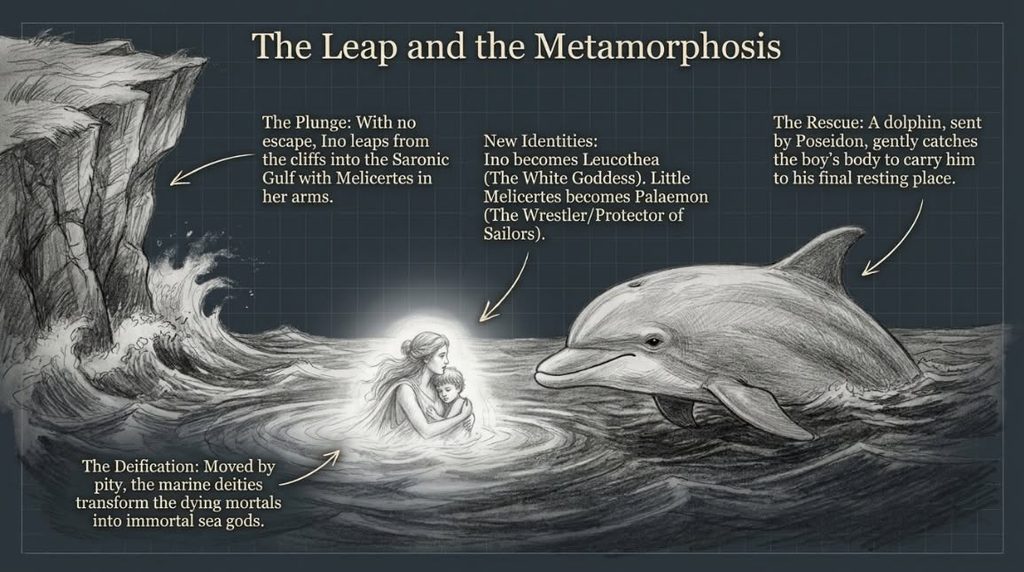
The story begins with Ino, daughter of Cadmus, the legendary founder of Thebes, and her young son Melicertes. In the mythological tradition, Ino became the wife of Athamas, king of Boeotia. Their household became entangled in the divine hostility of Hera, whose anger was associated with the persecution of Dionysus and those who protected the infant god. The resulting tragedy varied in detail across ancient accounts, but its central themes remained consistent: divine vengeance, madness, maternal desperation, and the transformation of suffering into sacred significance.
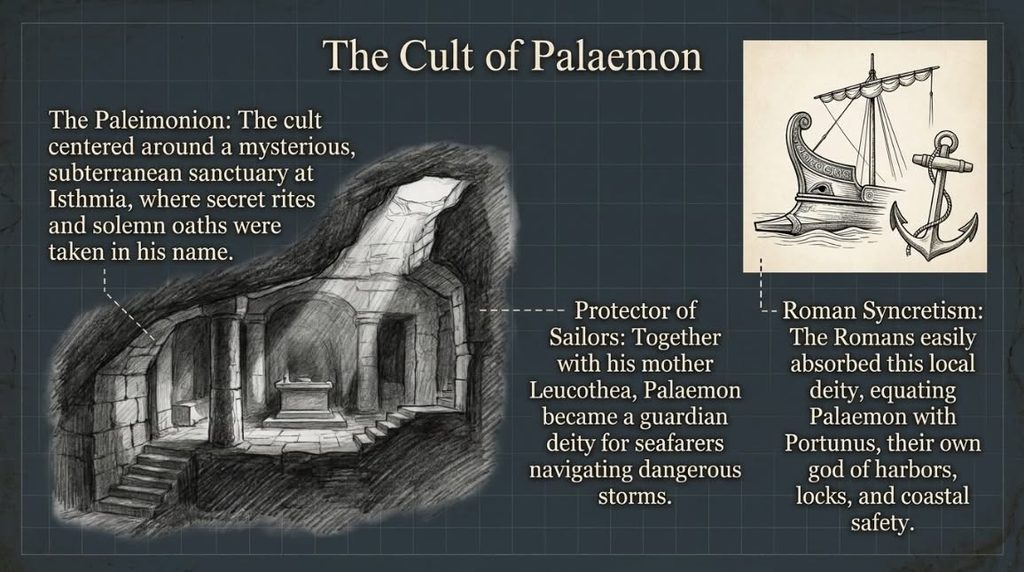
In one celebrated version, Athamas was driven into madness and killed his son Learchus. Ino fled with Melicertes, pursued by her husband, and ultimately leapt into the sea with the child. Their apparent destruction did not mark the end of their story. The sea gods transformed the mother and child into maritime divinities: Ino became Leucothea, the White Goddess, while Melicertes became Palaemon, a protector associated with sailors and maritime safety.
The dolphin occupies the decisive moment between death and divinity. Rather than allowing the child to disappear into the depths, the creature carries him towards the shore. In artistic representations of this myth, the dolphin is not simply an element of marine scenery. It is the agent of deliverance, connecting the mortal world with the divine realm and the tragic circumstances of Melicertes with his eventual worship.
For Corinth, this transformation was especially meaningful. The city stood beside the Isthmus, a narrow land bridge between mainland Greece and the Peloponnese, where maritime commerce, religious activity, and athletic competition converged. A myth involving a drowned child rescued by a dolphin would have resonated with communities whose prosperity and security depended heavily upon the sea.
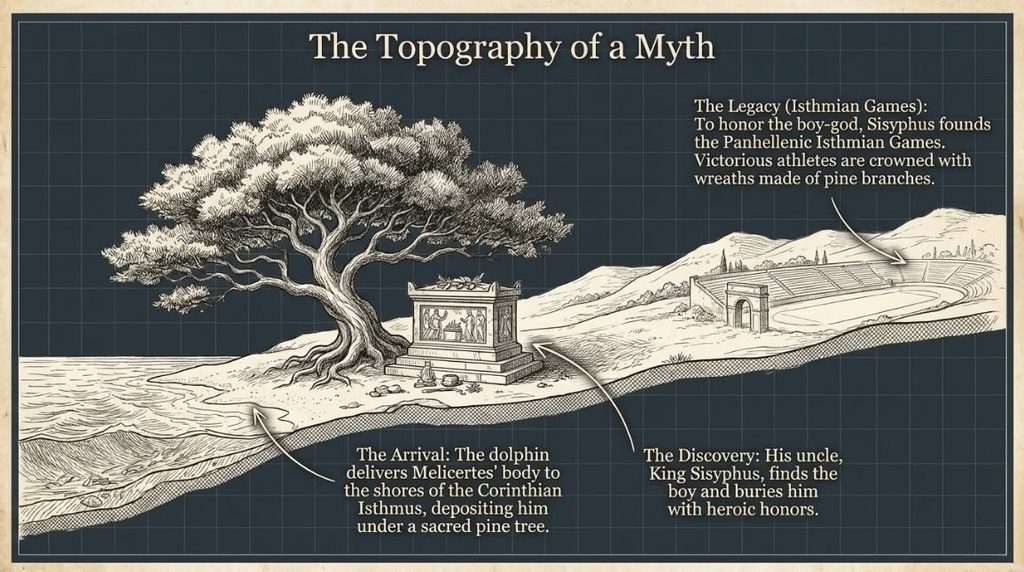
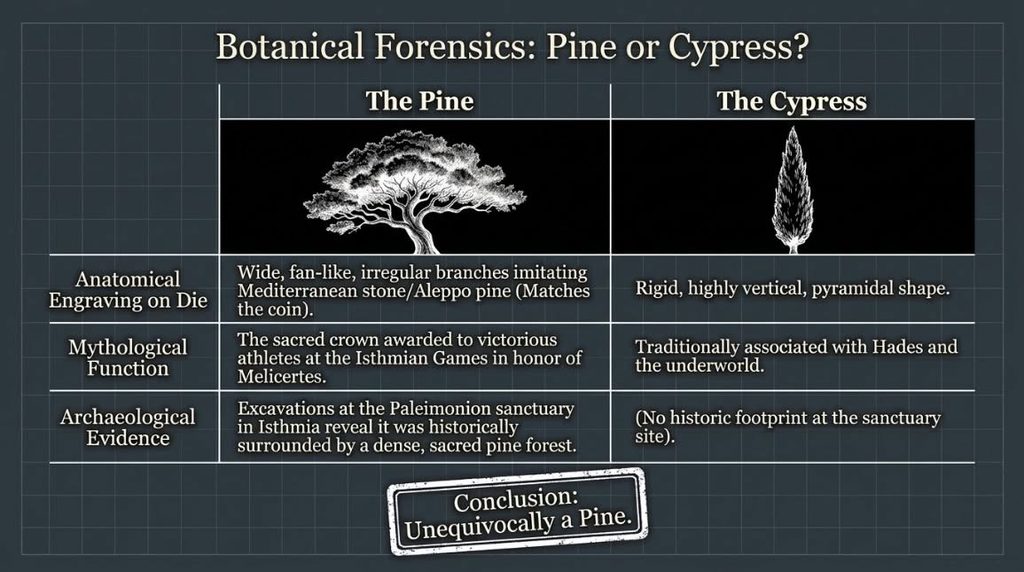
Perhaps the most revealing feature of the reverse is the pine tree standing behind Palaemon. Its presence distinguishes this coin type from a simple depiction of a mythological figure riding a dolphin. The tree identifies the scene with a particular sacred landscape and connects the image to the traditions surrounding the Isthmian Games.
The second-century AD travel writer Pausanias provides particularly important evidence. In his Description of Greece, Book 2, section 1.3, he describes a pine tree growing beside the shore in Corinthian territory, near an altar dedicated to Melicertes. According to the local tradition he records, a dolphin brought the boy to that place, where Sisyphus found him and arranged his burial. Pausanias further associates the discovery with the establishment of the Isthmian Games in Melicertes’ honor.
This testimony is invaluable because Pausanias visited Greece during the second century AD, broadly contemporary with the production of the coin. His account does not prove that the particular tree depicted on the bronze was the very tree he saw, but it demonstrates that the association between Melicertes, the pine, and the Corinthian coastline belonged to the religious traditions of the period.
The pine also carried a wider athletic significance. The Isthmian Games were among the great Panhellenic festivals, attracting competitors and spectators from across the Greek world. Traditionally associated with Poseidon, the games also possessed an important mythological connection with Melicertes. Ancient literary sources describe changes in the athletic prize, including periods when wreaths of pine were awarded to victors. The tree on the coin therefore evokes not only the place where the child was believed to have come ashore but also the enduring prestige of a major religious and athletic institution.
Its spreading branches may be interpreted as a visual reference to the sacred pine and the landscape associated with the cult. Nevertheless, the exact botanical species cannot be established from the engraving alone. The strongest evidence for the tree’s meaning comes from the combined numismatic and literary context, rather than from an attempt to identify its species solely by appearance.
The inscription C L I COR expands to Colonia Laus Iulia Corinthiensium, conventionally understood as referring to the Roman colony of Corinth, associated with Julius Caesar’s re-foundation of the city.
This inscription is crucial to interpreting the coin. Although the emperor’s portrait belongs to the wider visual language of Roman authority, the reverse speaks directly to Corinth’s civic identity. The city was not merely reproducing an imperial design. It was using its own provincial coinage to present a religious tradition deeply embedded in its landscape and public life.
Corinth had suffered destruction at the hands of the Roman commander Lucius Mummius in 146 BC before being refounded as a Roman colony by Julius Caesar in 44 BC. The later city developed into an important commercial and administrative center within the province of Achaea. Its Roman political identity did not erase its Greek religious inheritance. Instead, the two traditions coexisted, allowing local myths and sanctuaries to remain central to civic representation.
The reverse legend consequently performs two functions. It identifies the issuing community while placing its local mythology within a recognizably Roman provincial monetary system. The result is a distinctive synthesis: Roman imperial authority on one side and Corinthian sacred memory on the other.
The bronze composition reflects the practical requirements of provincial currency, which supported everyday transactions within local economies. Yet the modest material does not diminish the cultural ambition of the design. Unlike precious-metal imperial issues intended to circulate across broader monetary networks, provincial bronze coins could communicate particularly specific local identities through their inscriptions, portraits, and reverse imagery.
The combination of Marcus Aurelius and Melicertes-Palaemon is therefore especially revealing. One figure embodies the political order of the Roman Empire; the other represents a local sacred tradition rooted in a particular coastline. Their appearance on opposite sides of the same coin illustrates how imperial government and regional identity could coexist within the material culture of Roman Greece.
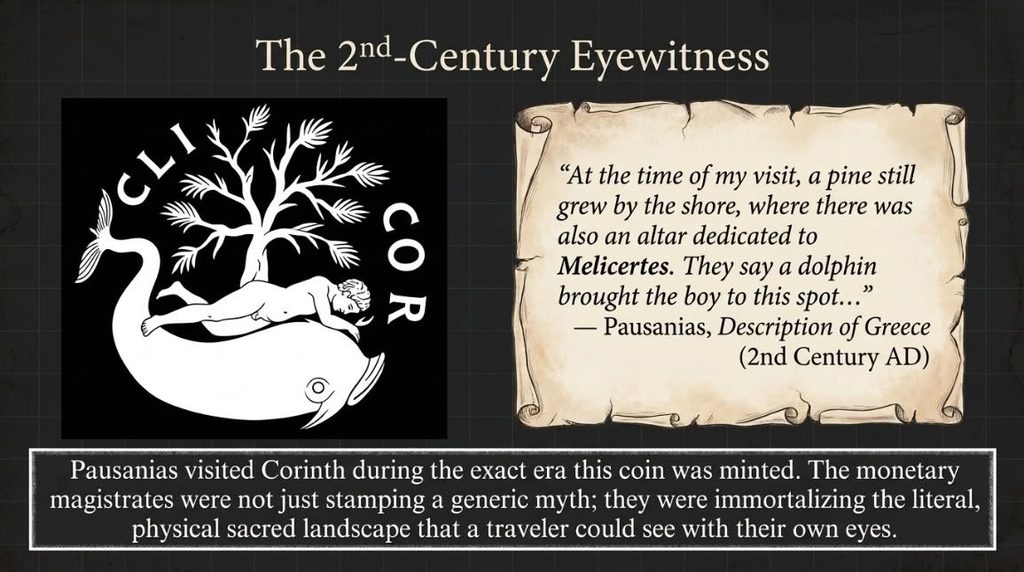
For modern numismatic study, this beautiful coin also demonstrates the value of interdisciplinary interpretation. Its inscriptions establish civic and imperial identities. Its iconography preserves a mythological narrative. Pausanias supplies a contemporary literary parallel for the pine tree, the dolphin, and the sacred site. Read together, these sources allow the coin to be understood as more than a dated artifact: it becomes evidence for the ways ancient communities represented their history, landscape, and religious beliefs.
This Corinthian bronze of Marcus Aurelius is a miniature monument to the relationship between myth, place, and political power. The laureate emperor establishes the historical setting of Roman rule, while the reverse preserves a story of tragedy transformed into divine protection. Melicertes, carried upon a dolphin beneath the sacred pine, embodies the religious imagination of a city whose identity was inseparable from the Isthmus.
The parallel with Pausanias is particularly compelling. His account records the same essential elements that appear on the coin: the pine beside the shore, the dolphin that carried the child, and the sanctuary traditions associated with Melicertes. Although the coin cannot independently prove every detail of the myth, its imagery offers tangible evidence that this story remained important in Corinthian civic culture during the Roman imperial period.
More than eighteen centuries after its production, the bronze continues to connect the viewer with a world in which currency could function simultaneously as money, civic declaration, and bearer of sacred memory. In the portrait of Marcus Aurelius and the image of Melicertes-Palaemon, imperial history and Greek mythology Coins meet in a single, enduring work of ancient art.
The significance of this coin lies not merely in the emperor it portrays, but in the landscape, legend, and religious identity it preserves. It is a remarkable testament to Roman Corinth and to the enduring power of myth to transform a small bronze object into a window onto the ancient world.