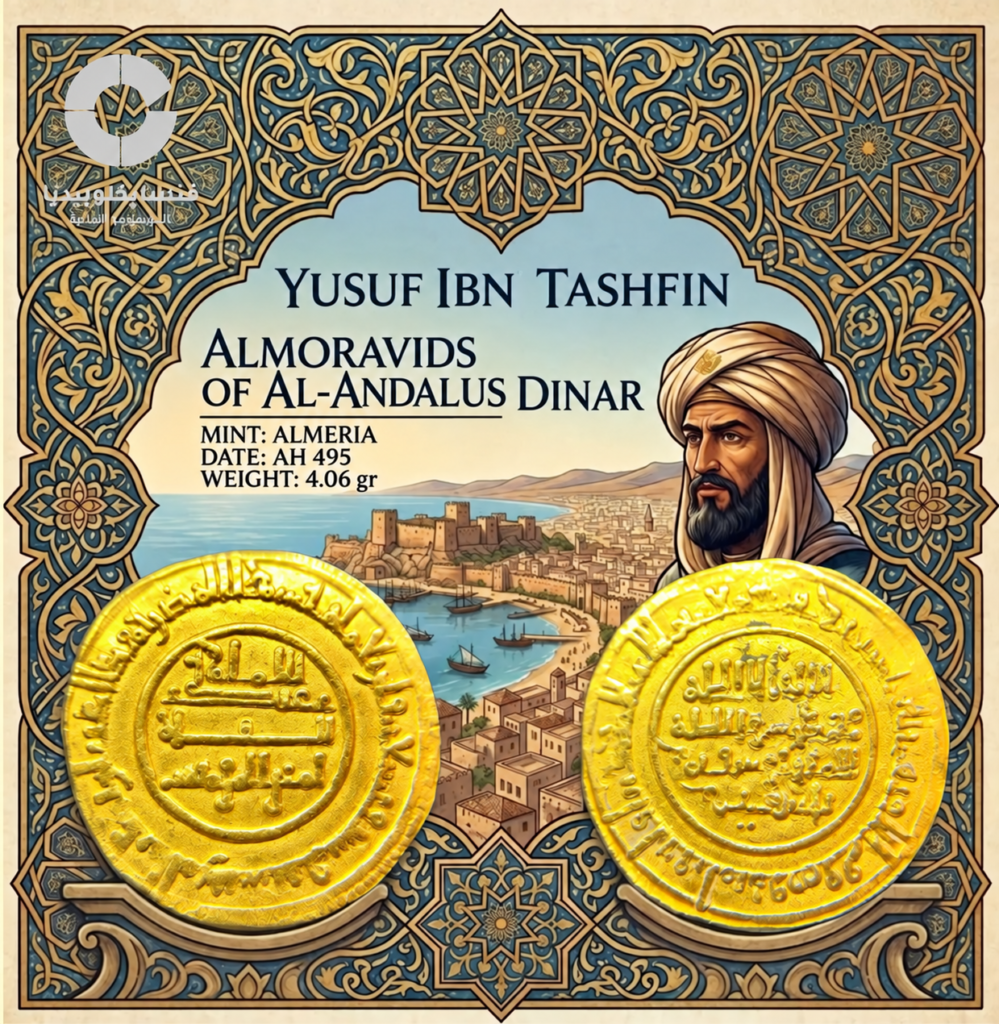
The Almoravid gold dinar stands among the most important Islamic gold coins of the medieval Western Mediterranean, combining monetary authority, political history, Islamic calligraphy and the extraordinary economic power of the Almoravid Empire. Struck during the eleventh and twelfth centuries across North Africa and Al-Andalus, these gold dinars became widely recognized beyond the territories ruled by the Almoravids and were later known in Christian sources by names derived from morabetino, ultimately contributing to the development of the medieval Spanish maravedí. The dynasty emerged from the Sanhaja Berber world of the western Sahara and established control over important trans-Saharan commercial routes, giving it access to gold moving north from West Africa.
This economic foundation was crucial to the development of a reliable gold currency. Under Yusuf ibn Tashfin, who ruled the Almoravid state from the late eleventh century until 1106 AD, the dinar became an especially powerful expression of imperial authority. The Spanish Ministry of Culture describes Almoravid gold dinars as high-quality pieces with a weight of approximately four grams, while the Museo de la Alhambra records an example of a Yusuf ibn Tashfin dinar weighing 4.06 grams. Yusuf ibn Tashfin was not simply a ruler whose name appeared on coins; his monetary system accompanied the extraordinary territorial expansion of the Almoravid state into the Iberian Peninsula.
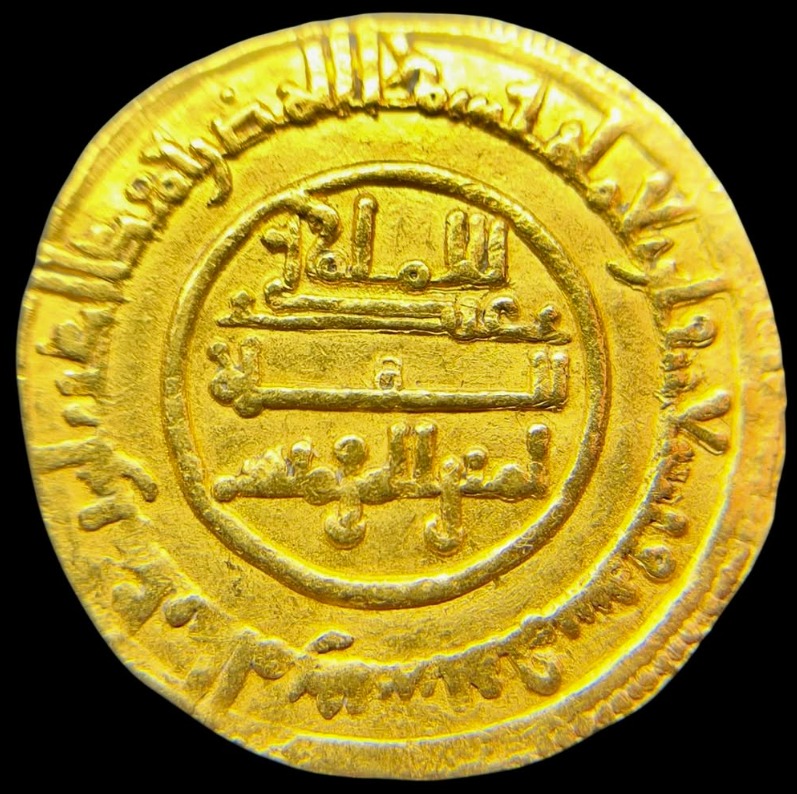
This dinar is From fincyclopedia
After the Almoravids intervened in Al-Andalus, their authority expanded across major Andalusian territories, and gold dinars were produced at a growing network of mints. Surviving examples demonstrate the geographical breadth of this monetary system, with Yusuf ibn Tashfin dinars associated with places including Sijilmasa, Córdoba, Seville, Granada, Almería, Valencia and other mints. Recent specialist auction records are particularly revealing: a Yusuf ibn Tashfin dinar dated AH 491 from Al-Mariya (Almería) was offered as an exceptionally rare issue, while examples from Córdoba, Seville, Málaga, Badajoz and other Andalusian cities demonstrate how extensive and varied his coinage could be.
The significance of the Yusuf ibn Tashfin dinar therefore extends far beyond its approximately four grams of gold. It represents the moment when the monetary authority of an emerging North African empire became deeply integrated into the economic and political landscape of medieval Iberia. For investors in historical precious metals, an authentic Almoravid gold dinar offers a remarkable convergence of intrinsic precious-metal value, documented historical context, ancient craftsmanship and numismatic rarity.
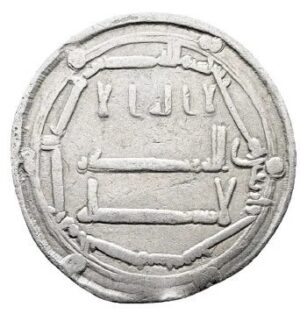
What makes the Yusuf ibn Tashfin gold dinar particularly fascinating is the deliberate sophistication of its design. Unlike many modern coins, these medieval Islamic gold coins generally do not rely upon a portrait of the ruler. Instead, authority is communicated through Arabic inscriptions arranged with remarkable precision. The central fields commonly contain religious declarations and the ruler’s titulature, while the surrounding inscriptions identify the mint, date and other elements of political and religious legitimacy. The Museo de la Alhambra’s documented Yusuf ibn Tashfin dinar, for example, is described as a circular but slightly irregular hammered gold coin with central epigraphic designs surrounded by marginal inscriptions. The museum identifies the ruler as Yusuf ben Tasufin and dates the particular example to 480 AH / 1087 AD, the first year of his formal rule, with a recorded weight of 4.06 grams. Other museum records explain the broader Almoravid monetary formula: the inscriptions could include the shahada, the ruler’s name and titles, recognition of Abbasid spiritual sovereignty, Qur’anic text and the denomination, mint and date. This makes an Almoravid dinar almost a miniature historical document. Its surface records the religious vocabulary, political hierarchy, monetary administration and geographic identity of the state that produced it. The Kufic script used on many Almoravid gold dinars is particularly important aesthetically. Its angular, monumental forms transform the coin into a small work of Islamic epigraphy, while the circular arrangement of the marginal legends creates a sophisticated visual balance around the central inscription.
The monetary standard was equally significant. Numismatic references generally place the Almoravid gold dinar around the four-gram range, and surviving museum specimens demonstrate remarkably consistent weights. A documented Yusuf ibn Tashfin dinar in the Museo de la Alhambra weighs 4.06 grams, while a published archaeological study of a Yusuf ibn Tashfin dinar struck at Valencia in 499 AH / 1105–1106 AD recorded 3.97 grams and a 24 mm module. This consistency was part of the reason Almoravid gold currency acquired such a strong reputation. Spanish museum documentation notes that the high-quality gold and reliable metrology of Almoravid dinars contributed to their role as an international currency of the period, and later Christian gold coinage drew upon the Almoravid monetary model. The famous term morabetino, ultimately associated with the Almoravids, became closely connected with the gold monetary tradition that followed. Thus, the Yusuf ibn Tashfin dinar should be understood not merely as an ancient gold coin but as an instrument of medieval monetary integration. It carried wealth across political boundaries while simultaneously carrying the identity of the Almoravid state.
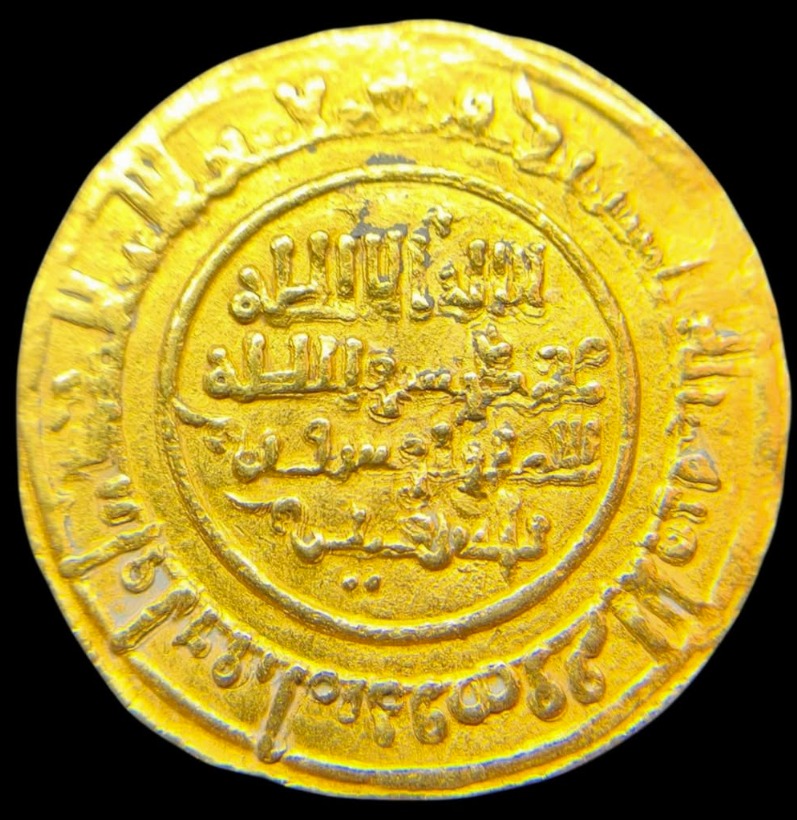
This Dinar is from fincyclopedia
Among the most compelling varieties of Almoravid gold currency are the dinars struck at Andalusian mints, including Al-Mariya — modern Almería. Their importance lies in the fact that they connect the physical gold of the Almoravid monetary system directly with the cities of medieval Al-Andalus. Specialist numismatic records confirm Yusuf ibn Tashfin issues from Almería, including an exceptionally rare AH 491 dinar. It is important, however, to distinguish individual coin types carefully: not every Yusuf ibn Tashfin dinar was struck at Almería, and not every coin dated AH 495 belongs to Al-Mariya. Recent auction documentation, for example, records particularly rare Yusuf ibn Tashfin dinars dated AH 495 from Córdoba, while the same auction records a Yusuf ibn Tashfin Al-Mariya dinar dated AH 491. This distinction is essential for serious numismatic research because the mint, date, inscription, die characteristics, weight, provenance and condition all contribute to the identification and historical significance of an individual Almoravid gold dinar.
For modern investors in ancient precious-metal assets, this combination creates a fascinating category in which tangible gold intersects with documented monetary history. A Yusuf ibn Tashfin dinar has survived for roughly nine centuries as a physical object, retaining the evidence of a monetary system that connected North Africa, the trans-Saharan gold trade and medieval Iberia. Its gold represents the material wealth of the period; its inscriptions preserve the political and religious language of the Almoravid state; its mint name records a specific geographic point within that vast economic network; and its survival provides a direct physical link to the reign of one of the defining rulers of medieval Maghreb and Al-Andalus.
The broader Almoravid monetary tradition also demonstrates how precious metals could function simultaneously as money, political communication and international economic infrastructure. Almoravid gold dinars circulated well beyond the immediate territories of their issuers, and their influence can be traced into later Iberian monetary traditions. For investors seeking ancient gold coins, Islamic gold coins, medieval gold dinars, Andalusian gold coins, Almoravid coins, Yusuf ibn Tashfin coins and historic precious-metal assets, these pieces occupy a uniquely compelling position. They are not simply remnants of an extinct currency; they are surviving units of a sophisticated medieval monetary civilization.
A genuine Yusuf ibn Tashfin dinar therefore embodies several layers of enduring value at once: the intrinsic presence of gold, the scarcity of surviving examples, the historical importance of the Almoravid dynasty, the artistic character of Islamic Kufic calligraphy, the economic history of trans-Saharan gold and the extraordinary story of Al-Andalus.
For House of Emirates®, such an ancient gold dinar represents precisely the kind of tangible historical treasure in which precious metal and civilization converge — a monetary artifact created almost a millennium ago that still communicates wealth, power and history today.
@The original poster of this article is from fincyclopedia