London – UK
The Roman Empire produced some of the most remarkable portrait coinage in human history. Among its most compelling surviving treasures are ancient Roman coins depicting women of the imperial household: empresses, imperial mothers, wives, daughters and influential female members of ruling dynasties. These coins provide an extraordinary historical record of women whose identities, political influence and dynastic importance were communicated throughout an empire extending from Britain to the Middle East and North Africa.
In a society traditionally dominated by male political authority, the appearance of an empress on an official Roman coin was a significant statement. Roman women were generally excluded from holding the emperor’s formal political office, yet their portraits circulated alongside those of emperors, senators and military leaders. Their images were reproduced in gold aurei, silver denarii, silver antoniniani, bronze sestertii, dupondii and asses, reaching soldiers, merchants, administrators and ordinary citizens across the Roman world.
Roman imperial coins was therefore much more than a monetary instrument. It was an exceptionally effective communication system. Through carefully selected portraits, inscriptions and reverse imagery, emperors communicated the values, legitimacy and continuity of their ruling houses. Empresses became essential participants in this visual language, representing motherhood, marital harmony, fertility, religious devotion, prosperity and the future stability of the imperial dynasty.
There were several important reasons why Roman emperors authorised coins depicting their wives and female relatives.
Dynastic legitimacy and succession
Perhaps the most important reason was the presentation of the imperial family as a continuing political institution. An emperor’s authority depended not only on military victories and administrative achievements but also on his ability to establish a recognised successor.
The empress was central to this objective. Her portrait could communicate the legitimacy of the ruling family, emphasise the production of legitimate heirs and reinforce the impression that the empire was governed by an established dynasty rather than by an isolated individual.
A Roman coin depicting an emperor and his empress therefore communicated a powerful message: the imperial household represented continuity, stability and the future of Rome.
Political influence and public recognition
Although Roman women did not normally hold the imperial office, some empresses exercised considerable influence over political appointments, succession, diplomacy, religious patronage and the emperor’s court.
Their portraits on coins gave these women an unprecedented degree of public visibility. Unlike statues confined to particular locations, coins travelled throughout the empire, making their images familiar to populations far removed from Rome itself.
Religious symbolism and divine associations
Roman empresses were frequently associated with goddesses such as Venus, Juno, Ceres, Diana and Vesta. These associations communicated particular qualities attributed to the imperial woman.
Venus represented beauty, fertility and divine ancestry. Juno symbolised marriage, motherhood and the protection of women. Ceres represented agriculture, fertility and abundance, while Vesta embodied sacred tradition and religious devotion.
By associating an empress with these divine figures, Roman coin designers elevated her public image and connected the imperial household with Rome’s religious traditions.
Virtues and idealised womanhood
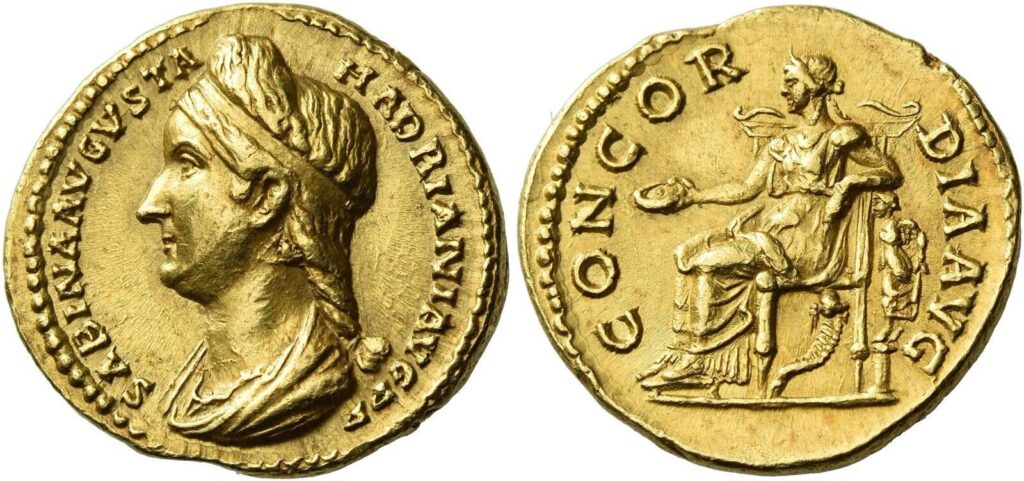
Coin inscriptions frequently presented empresses through concepts such as PIETAS (religious devotion), PVDICITIA (modesty and chastity), CONCORDIA (harmony), FECVNDITAS (fertility) and IVNO (Juno).
These were not arbitrary decorations. They communicated the virtues that the imperial family wanted the population to associate with its female members.
Livia Drusilla (58 BC–AD 29), wife of Emperor Augustus, occupies a foundational position in the history of Roman imperial women.
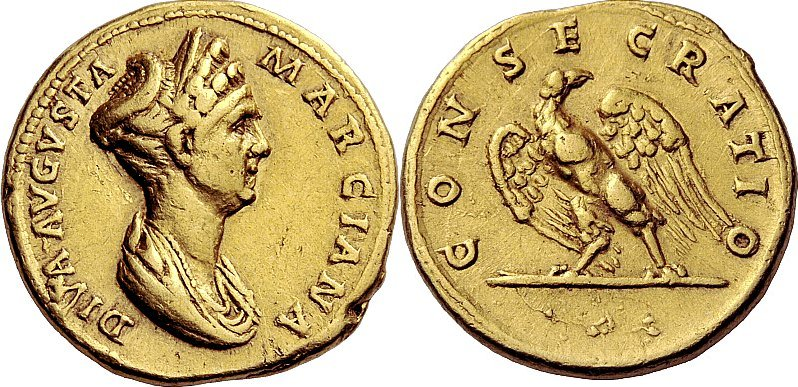
Although she was one of the most influential women of the early Empire, her representation on official Roman coinage was comparatively restricted during Augustus’s reign. Her appearance on a sestertius issued in AD 22–23, with the inscription S P Q R IVLIAE AVGVST, is an important example of the public recognition of her status.
Livia’s importance extended far beyond her position as the emperor’s wife. She was the mother of Tiberius, who succeeded Augustus, and was central to the dynastic relationships that shaped the Julio-Claudian succession.
Her coinage demonstrates how the imperial household gradually became a subject of official monetary representation.
Agrippina the Younger (AD 15–59) was one of the most politically significant women of the Julio-Claudian dynasty.
She was the daughter of Germanicus, sister of Emperor Caligula, wife of Emperor Claudius and mother of Emperor Nero. Her remarkable family connections made her an important figure in imperial politics.
Her appearance on Roman coinage reflected the importance of her position within the ruling dynasty. Some issues associated with her and Nero presented the imperial mother and son together, visually reinforcing the relationship between the established imperial family and its successor.
Agrippina’s numismatic legacy is especially interesting because it illustrates how female portraiture could communicate both family legitimacy and political influence.
Annia Galeria Faustina, known as Faustina the Elder (c. AD 100–140), wife of Emperor Antoninus Pius, is among the most recognisable women in Roman numismatics.
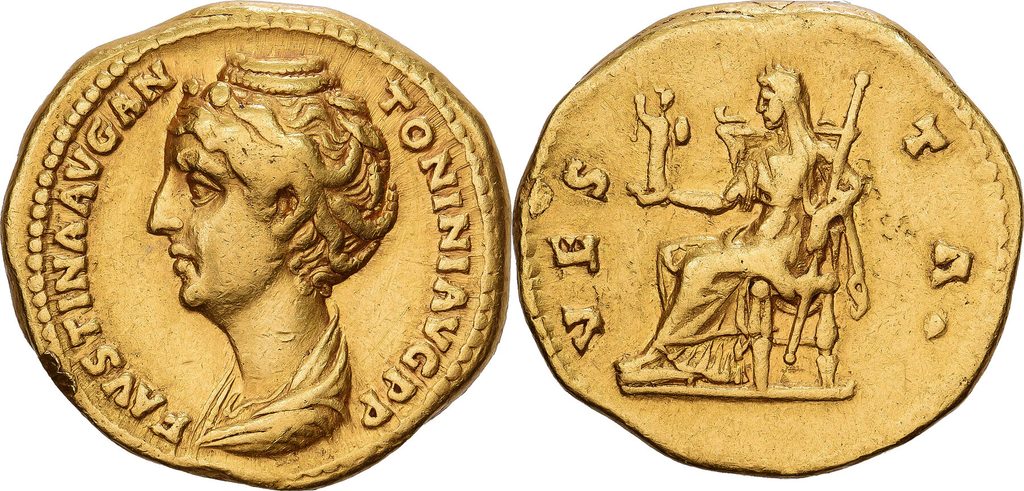
After her death in AD 140, she was officially deified. Her portrait appeared on extensive commemorative coin issues bearing the title DIVA FAVSTINA, meaning the deified Faustina.
These coins are especially important because they demonstrate how Roman imperial women could acquire a religious dimension after death.
Many of her commemorative issues feature reverse representations associated with Aeternitas, Ceres, Pietas and other divine or personified concepts.
Her coinage was not simply a memorial to a deceased empress. It helped establish an enduring imperial cult and reinforced the prestige of the Antonine dynasty.
Faustina the Younger (c. AD 130–175), daughter of Antoninus Pius and wife of Emperor Marcus Aurelius, represents another remarkable chapter in Roman female portrait coinage.
Her coins are particularly significant because of their association with fertility and motherhood. The legend FECVNDITAS, accompanied by imagery representing children and maternal symbolism, communicated the importance of producing heirs for the imperial family.
She was the mother of several children, including the future Emperor Commodus.
Her portraiture was widely distributed, and her coins provide valuable evidence of the way imperial motherhood was presented as a matter of public importance.
Julia Domna (c. AD 160–217), wife of Emperor Septimius Severus and mother of Emperors Caracalla and Geta, is among the most celebrated female figures in ancient Roman numismatics.
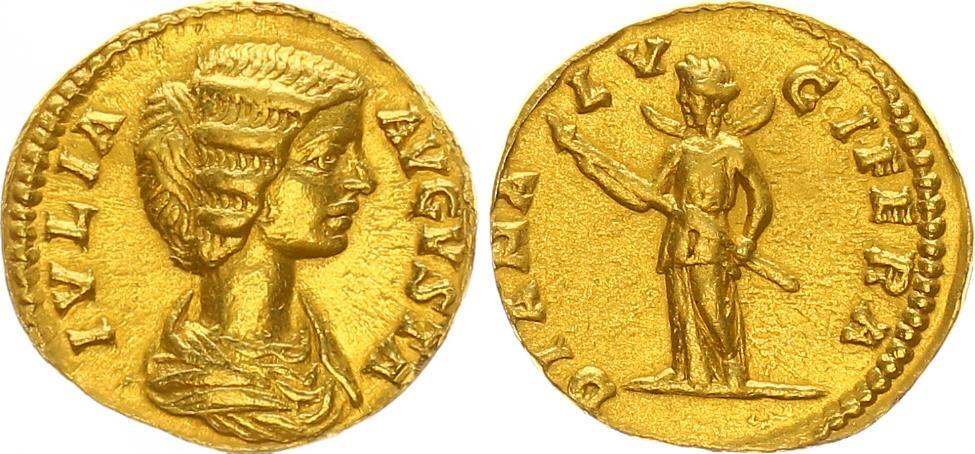
Her coinage is particularly extensive and historically significant. She appeared on numerous silver denarii, gold aurei and other denominations issued during the Severan dynasty.
Her portraits frequently feature the inscription IVLIA AVGVSTA, identifying her imperial status.
The reverse designs associated with Julia Domna include representations of Juno, Venus, Diana, Vesta, Cybele and other divine figures. These images connected the empress with religious traditions, motherhood, imperial stability and the welfare of Rome.
Her importance went beyond symbolism. Ancient literary sources and modern historical scholarship recognise her substantial political and cultural influence.
Some coin issues also associate her with LIBERALITAS, the imperial virtue of generosity. Such representations demonstrate the role of imperial women in supporting the public image and social policies of the ruling dynasty.
The Severan dynasty produced several exceptionally influential imperial women.
Julia Maesa, sister of Julia Domna, was instrumental in the political developments that brought Elagabalus and subsequently Severus Alexander to power.
Her coins identify her as IVLIA MAESA AVGVSTA and present her as an important member of the imperial family.
Her daughter, Julia Mamaea, mother of Emperor Severus Alexander, also appeared on imperial coinage. Her political influence was considerable, particularly during her son’s reign.
Their numismatic representations demonstrate that imperial women could remain important political figures even when they were not married to the reigning emperor.
Cornelia Salonina, wife of Emperor Gallienus (AD 253–268), represents the extraordinary importance of female coinage during the turbulent third century.
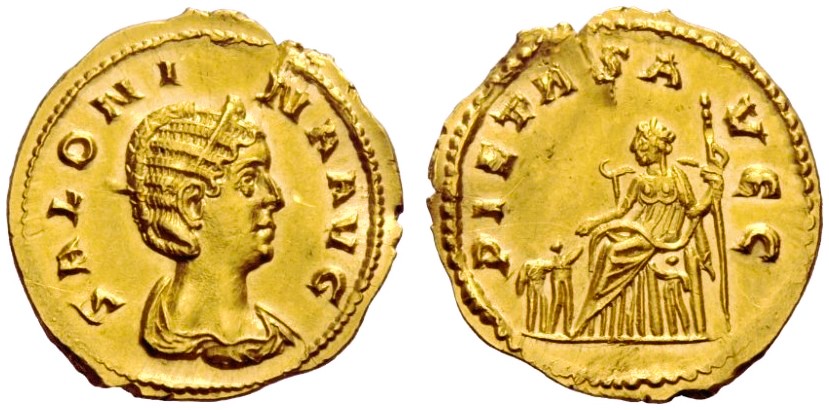
The Roman Empire experienced military instability, economic difficulties, competing claimants to the throne and repeated political upheavals during this period.
Salonina appeared on antoniniani and other imperial issues, often with the title SALONINA AVG.
Her coinage included representations of divine figures and virtues, reflecting the imperial family’s desire to communicate stability and legitimacy during an exceptionally difficult historical period.
The reverse of a Roman coin is often just as historically important as the portrait of the empress on its obverse.
Several recurring images deserve particular attention:
For modern numismatists, these inscriptions and images are essential when identifying, dating and interpreting ancient Roman coins.
Roman empress coins were produced in different metals and denominations, each reflecting the monetary and political priorities of its period.
Gold aurei were prestigious denominations associated with substantial financial transactions and imperial authority. Silver denarii were among the most recognisable Roman denominations, circulating widely throughout the Empire. Later, antoniniani became particularly important during the third century. Bronze sestertii, dupondii and asses also played a major role in everyday monetary circulation.
The portrait styles changed considerably over time. Early imperial women were frequently represented with carefully arranged hairstyles and idealised facial features. During the Antonine and Severan periods, elaborate hairstyles became a distinctive artistic feature, particularly in the portraits of Faustina the Younger and Julia Domna.
These details make Roman empress coins valuable not only as historical monetary objects but also as miniature works of ancient portrait art.
Their inscriptions, hairstyles, portrait styles, metal composition, mint marks and reverse imagery help researchers establish chronology, identify imperial authorities and understand changing artistic conventions.
Roman empress coins occupy a distinctive position in the international ancient coin market.
Their appeal comes from several factors: historical significance, the identity of the female ruler, rarity, denomination, metal, condition, portrait quality, reverse design and documented provenance.
Coins depicting particularly influential women, such as Livia, Agrippina the Younger, Faustina the Elder, Faustina the Younger and Julia Domna, attract sustained numismatic interest.
Roman Gold aurei featuring imperial women are especially prestigious, while silver denarii and antoniniani provide more accessible opportunities to acquire historically important Roman imperial portraiture.
For buyers seeking to purchase ancient Roman coins, it is important to examine authenticity, preservation, surface condition, weight, diameter, inscriptions, die characteristics and provenance. A rare-looking portrait alone does not establish rarity or market value. Proper attribution and independent specialist assessment are essential.
The historical significance of a coin should also be distinguished from its financial performance. Ancient coins are tangible historical objects, not guaranteed investments, and their market values can fluctuate according to demand, rarity and condition.

House of Emirates® in London recognises the exceptional cultural, historical and artistic significance of ancient Roman coinage.
Roman coins depicting empresses represent a remarkable intersection of imperial politics, female influence, religious symbolism and artistic heritage. Each authentic coin offers a direct material connection to the ancient world, preserving the portraits and messages through which Rome communicated its power across continents.
For discerning buyers interested in ancient Roman gold coins, silver denarii, imperial portraits and rare historical treasures, these pieces offer an opportunity to own tangible objects of extraordinary historical significance.
House of Emirates® — London — Where Eternity Becomes a Luxury Asset.
Why did Roman emperors put their wives on coins?
Empresses appeared on Roman coins to communicate dynastic legitimacy, family continuity, religious values, fertility, imperial virtues and the stability of the ruling household.
Who was the first Roman empress to appear on coins?
The development was gradual. Female figures appeared on Republican and early imperial issues before the systematic use of named imperial female portraits. Livia received official monetary recognition, while the reign of Caligula marked an important development in identifying living imperial women by name and portrait.
Which Roman empress has the most recognisable coinage?
Julia Domna, Faustina the Elder and Faustina the Younger are among the most recognisable and extensively represented imperial women in Roman numismatics.
What are the most valuable Roman empress coins?
Values depend on rarity, authenticity, metal, condition, historical importance and provenance. Gold aurei featuring important empresses can command substantial prices, although exceptional silver and bronze issues can also be highly desirable.
Where can I buy authentic Roman empress coins?
Authentic ancient Roman coins depicting empresses can be sourced through established specialist numismatic dealers, reputable auction houses and trusted ancient coin retailers. Buyers should prioritise accurate attribution, authenticity guarantees, transparent provenance and applicable cultural-property and import regulations.
What should I look for when purchasing a Roman empress coin?
Examine the obverse portrait, reverse imagery, inscriptions, denomination, weight, diameter, mint attribution, condition, authenticity and provenance. Specialist numismatic expertise is particularly important when purchasing rare imperial issues.