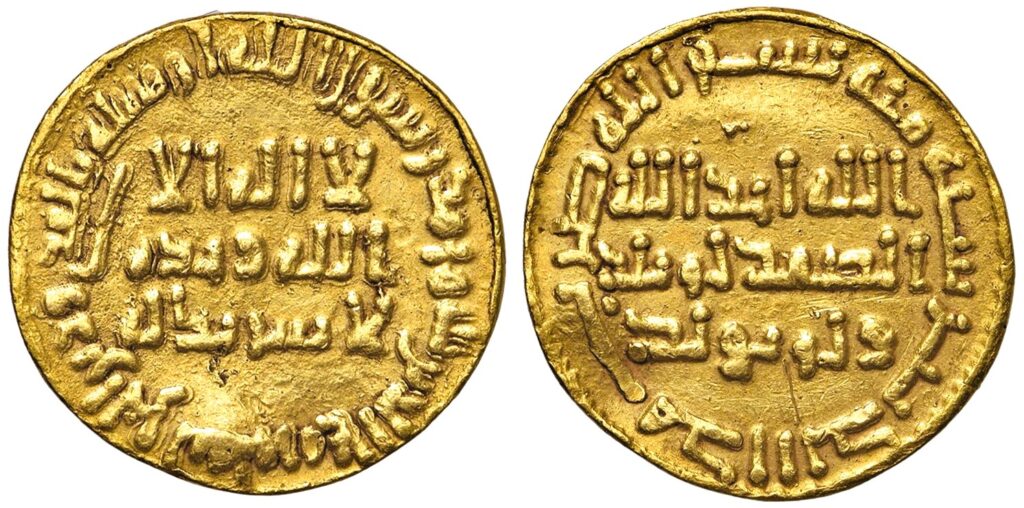
The Umayyad gold dinar stands among the most historically significant coins of the early Islamic world. Struck during the Umayyad Caliphate, particularly following the sweeping monetary reforms of Caliph ʿAbd al-Malik ibn Marwan, these early Islamic gold coins represent a decisive moment in the development of an independent Islamic monetary system. Today, genuine Umayyad gold dinars, especially well-preserved examples with clear inscriptions, identifiable dates and documented provenance, are highly important pieces of Islamic numismatics. For investors in ancient coins, specialists in Islamic coinage, and anyone researching the history of early Islamic gold currency, understanding how to identify an Umayyad dinar—and how to distinguish genuinely scarce varieties from more frequently encountered examples—is essential.
The monetary transformation associated with ʿAbd al-Malik is particularly important. Before the reform, Islamic territories continued to use monetary traditions inherited from the Byzantine and Sasanian worlds. Early Islamic gold coinage could therefore retain portraits, crosses, fire altars and other visual elements derived from earlier imperial currencies. In approximately 696–697 AD (AH 77), ʿAbd al-Malik introduced a radically different gold coinage: the fully epigraphic Islamic dinar. Instead of imperial portraits and figurative imagery, the new coins communicated their identity through Arabic inscriptions, Islamic declarations of faith and Qur’anic text. The Metropolitan Museum of Art describes the reform of 696–97 as producing entirely new gold coin types without figural imagery.
This transformation makes the Umayyad dinar of 77 AH especially important in the study of Islamic coins. A British Museum example attributed to ʿAbd al-Malik, dated AH 77 / 696–697 AD, is recorded as a gold dinar from Damascus weighing 4.250 grams and measuring approximately 20 millimetres. The date is therefore not simply an inscriptional detail: it places the coin at the beginning of one of the most consequential monetary reforms in Islamic history.
An Umayyad gold dinar is a gold denomination issued under the Umayyad Caliphate (661–750 AD). The term “dinar” derives from the wider Mediterranean monetary tradition associated with the Roman denarius aureus and Byzantine gold currency, but under the Umayyads the denomination became an important component of the emerging Islamic monetary system.
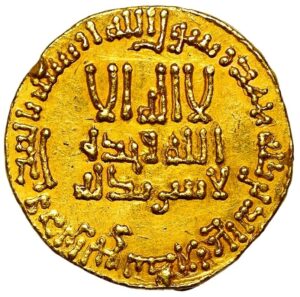
For the serious student of Islamic gold coins, the most recognizable Umayyad dinars are the post-reform, purely epigraphic types. Their design is deliberately restrained. There is no portrait of the caliph, no throne, no crown and no animal or architectural scene. Instead, the coin’s identity is expressed through Arabic calligraphy.
A classic post-reform Umayyad gold dinar generally has a central inscription surrounded by a circular legend on one side and another central inscription surrounded by a dated marginal inscription on the other. A Met example dated AH 79 / 698–699 AD records the shahada in the central field and Qur’anic text in the surrounding legend, while the reverse includes the declaration that the coin was struck in the specified year.
This epigraphic character is one of the principal features used in Umayyad coin identification. However, identification should never rely on appearance alone. Date, inscription, calligraphic style, weight, diameter, mint attribution, die characteristics, fabric, metal composition and provenance all contribute to a proper numismatic assessment.
For collectors and investors researching Umayyad gold dinars for sale, the Arabic inscriptions are among the most valuable diagnostic features.
The central inscription on the obverse of many post-reform dinars expresses the Islamic profession of faith:
“There is no god but God alone; He has no associate.”
The surrounding inscription commonly contains a declaration identifying Muhammad as the Messenger of God together with Qur’anic wording. On the reverse, the central field frequently contains text derived from Qur’an 112, while the surrounding legend gives information concerning the striking of the coin and its date.
The Metropolitan Museum’s example of the AH 79 dinar provides a particularly useful reference because its catalogue records both the Arabic inscriptions and their translations.
For this reason, anyone attempting ancient Islamic coin identification should learn to read—or work with a qualified specialist who can read—the inscription rather than relying only on photographs. Small differences in letter forms, spacing, marginal legends and dates can distinguish different varieties.
One of the greatest advantages of Umayyad gold dinars is that many post-reform examples carry explicit dates. This is extraordinarily useful for historians and numismatists.
Islamic dates are normally expressed according to the Hijri calendar (AH). Consequently, a coin dated AH 77 belongs approximately to 696–697 AD, while AH 79 corresponds to approximately 698–699 AD.
The British Museum records an Umayyad gold dinar of AH 78 / 697 AD, weighing 4.260 grams, while another example dated AH 88 / 706 AD weighs 4.270 grams. These museum records demonstrate why both the date and physical measurements matter when identifying an Umayyad gold coin.
The date can also influence rarity. A date from the earliest years of the reformed coinage may have particular historical importance, while an unusual date, rare variety or scarce die combination may make an individual specimen substantially more distinctive than another dinar from the same ruler.
Weight is another important component of Umayyad dinar authentication.
The gold dinar was based upon an established monetary weight system, and surviving museum examples commonly fall around the 4.2–4.3 gram range. The British Museum records, for example, an AH 77 dinar at 4.250 grams, an AH 78 example at 4.260 grams, an AH 88 example at 4.270 grams and an AH 126 example at 4.260 grams.
However, weight alone cannot authenticate an ancient gold coin. Ancient coins can experience edge loss, clipping, corrosion, wear, surface deposits or other physical changes. Some surviving examples also have holes or other alterations. The British Museum, for example, records an Umayyad gold coin of AH 117 weighing 4.240 grams but notes that it had been holed.
Consequently, a genuine Umayyad gold dinar should be assessed as a complete numismatic object rather than by a single measurement.
The importance of these coins extends far beyond their gold content.
The monetary reform under ʿAbd al-Malik represented a major assertion of Islamic political, religious and economic identity. The replacement of inherited Byzantine and Sasanian imagery with Arabic inscriptions created a distinctly Islamic visual language for imperial currency.
The Metropolitan Museum notes that earlier Umayyad coinage continued to draw upon Byzantine and Sasanian traditions, while the reforms associated with ʿAbd al-Malik introduced new gold coins featuring Islamic inscriptions and Qur’anic phrases.
The British Museum similarly explains that Islamic gold dinars subsequently became influential far beyond territories directly governed by Muslim rulers. Dinar types were circulated and even imitated in western Europe; one famous example is the gold imitation produced under Offa of Mercia, demonstrating the reach and recognition of the Islamic gold coinage system.
Thus, an Umayyad gold dinar is simultaneously an ancient gold asset, an archaeological object, an Islamic historical artifact and a document of monetary history.
The phrase “rare Umayyad gold dinar” should be used carefully. Not every Umayyad dinar is equally rare, and rarity can mean several different things in ancient numismatics.
The first category is absolute rarity: relatively few examples of a particular coin type, date or variety are known.
The second is market rarity: examples may survive in institutional collections, but very few appear on the market.
The third is condition rarity: examples exist, but very few survive in exceptional preservation with sharp inscriptions, attractive surfaces and minimal damage.
The fourth is die rarity: a particular combination of obverse and reverse dies may be represented by only a small number of surviving coins.
Finally, there is historical rarity. A coin associated with a pivotal moment, unusual monetary reform, rare mint or historically significant ruler may command particular scholarly interest even if related examples are known.
For investors researching rare Islamic coins, these distinctions are important. “Rare” should not simply mean old. A coin can be approximately 1,300 years old and still have numerous surviving examples, while another apparently similar coin may be genuinely scarce because of its date, mint, die combination or historical circumstances.
Mint attribution can be critical when evaluating an Umayyad gold dinar.
The earliest post-reform gold dinars are strongly associated with the central monetary administration of the caliphate, and Damascus is particularly important in the history of Umayyad coinage. The British Museum identifies its AH 77 gold dinar as minted in Damascus. The mint, when identifiable, provides another layer of information about the coin’s historical context. It can help establish where the monetary authority was operating, how coinage circulated and how regional production developed.
For Islamic coin collectors and investors, mint identification is therefore not merely a catalogue detail. It can materially affect the historical significance and comparative rarity of an individual specimen.
Condition is particularly important for gold coins because the metal can preserve inscriptions and surfaces remarkably well, yet ancient production and subsequent circulation can leave distinctive marks.
On an Umayyad gold dinar, specialists examine the sharpness of the Kufic lettering, completeness of the legends, centring of the strike, surface quality, edge condition, evidence of clipping, scratches, mounting, holes and other alterations. A beautifully centred coin with complete legends may be significantly more desirable than an example with major portions of the inscription missing—even if both technically represent the same date and type.
For high-quality ancient Islamic gold coins, preservation of the original surfaces is therefore a major consideration.
The market for ancient gold coins naturally attracts reproductions and modern forgeries. Consequently, authentication is fundamental.
An authentic Umayyad dinar should exhibit consistency between its weight, diameter, fabric, strike, Arabic calligraphy, die characteristics, gold composition and expected historical technology.
One should be particularly cautious with coins offered solely on the basis of a dramatic description such as “extremely rare Islamic gold coin” without supporting information.
A responsible assessment should consider multiple independent characteristics. High-resolution photography can assist preliminary examination, but professional authentication may require physical inspection, comparison with published specimens and, when appropriate, scientific analysis.
Museum collections provide valuable reference points. The British Museum’s published records, for example, provide dates, weights, diameters, rulers, denominations and bibliographic references for numerous Umayyad dinars.
The appeal of an Umayyad gold dinar is unusual because it combines tangible precious metal with extraordinary historical depth.
The intrinsic gold content is one component. The numismatic premium is another. Historical importance, rarity, condition, provenance and market demand can all influence the value of an ancient gold coin.
This is why the study of ancient Islamic gold coins, Umayyad gold coins, rare gold dinars, early Islamic coins and Islamic numismatics requires considerably more sophistication than simply comparing gold weight.
A modern bullion coin primarily represents its metal value and contemporary issuing authority. An Umayyad dinar additionally represents a specific historical period, ruler, monetary reform, inscriptional tradition and surviving archaeological record.
The importance of the Umayyad monetary system can also be understood through what came afterward.
Following the end of Umayyad rule in 750 AD, the Abbasids established a new caliphate, but the fundamental concept of the Islamic gold dinar continued. Gold dinars remained an important denomination across the Islamic world, with different dynasties adapting inscriptions, names, dates and mint information.
The British Museum’s Islamic collections demonstrate this continuity through gold dinars of later Abbasid rulers.
Consequently, the Umayyad dinar is not simply one ancient Islamic coin among many. It occupies a foundational position in the evolution of Islamic monetary culture.
A serious investigation should begin with the ruler and date, followed by the inscriptions, mint, weight, diameter and type. The next stage is comparison with established museum and scholarly references. Museum databases are particularly valuable because they provide images and technical information for known specimens. The British Museum and Metropolitan Museum of Art both maintain important online records of early Islamic gold coins.
The final stage is provenance and authenticity assessment. A documented provenance can provide additional confidence and historical context, although provenance alone does not prove authenticity. Likewise, an attractive appearance does not establish rarity.
For anyone considering purchasing a rare Umayyad gold dinar, the objective should therefore be to understand precisely what the coin is before considering its financial significance.
The extraordinary appeal of the Umayyad gold dinar comes from the convergence of history, religion, art, monetary innovation and precious metal.
A coin struck during the reign of ʿAbd al-Malik can preserve, in only a few centimetres of gold, evidence of one of the most important transformations in early Islamic civilization. Its inscriptions reveal the religious and political language of the period. Its weight records an ancient monetary standard. Its Arabic calligraphy reflects the development of Islamic visual culture. Its gold connects the object to a sophisticated monetary economy extending across enormous territories.
For researchers searching for the best Umayyad gold dinars, rare Islamic gold coins, ancient Islamic coins for sale, Umayyad coins, Islamic gold dinars, early Islamic gold coins, rare Islamic coins, Abd al-Malik dinars, Umayyad Caliphate coins, AH 77 gold dinar, AH 78 gold dinar, AH 79 gold dinar, and authentic ancient Islamic coins, the central lesson is simple: rarity must be demonstrated through numismatic evidence rather than asserted through marketing language.
A truly important Umayyad dinar is identified by its historical context, inscriptions, date, mint, physical characteristics, condition, provenance and established numismatic classification. When these elements converge, the result is much more than an ancient piece of gold. It becomes a surviving document from the formative centuries of Islamic civilization.
House of Emirates® presents ancient Islamic coinage within this broader tradition of tangible historical wealth. For those researching rare Umayyad gold dinars, Islamic gold coins, ancient gold coins, early Islamic coinage and investment-grade ancient treasures, careful identification remains the foundation of responsible acquisition. In an increasingly digital world, these physical objects offer something fundamentally different: an authentic connection to a monetary system created more than thirteen centuries ago, preserved in gold and carried into the present.
House of Emirates® — London — Where Eternity Becomes Luxury Asset.