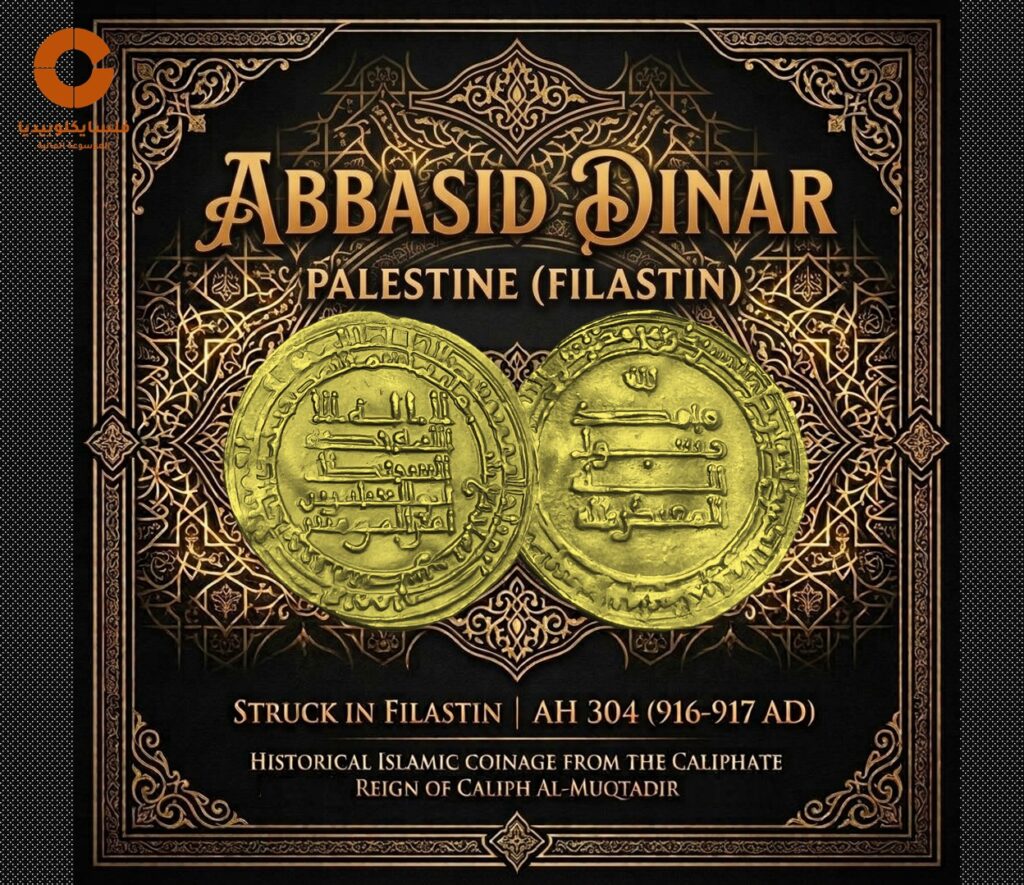
The Abbasid gold dinars struck in Palestine represent a remarkable chapter in the history of Islamic monetary civilisation, connecting the economic power of the early Islamic world with the religious, political and commercial importance of the Holy Land. Produced during the Abbasid Caliphate (750–1258 AD), these gold coins reflect the sophisticated monetary system, administrative organisation and artistic traditions that helped shape the medieval Middle East. For historians, archaeologists, numismatists and investors in historical tangible assets, Abbasid gold dinars associated with Palestine offer an exceptional opportunity to explore the relationship between Islamic history, precious metals, trade and the development of a vast international economy.
Palestine occupied a strategically important position within the early Islamic world. Situated between Egypt, Syria and the Arabian Peninsula, the region connected Mediterranean ports, inland trading centres, agricultural settlements and major pilgrimage routes. Jerusalem, known in Arabic as al-Quds, held profound religious significance, while Ramla, established in the early eighth century, developed into an important administrative and commercial centre. Following the Abbasid Revolution in 750 AD, the new caliphal dynasty inherited an established gold currency system and continued to rely on gold dinars for high-value transactions, international commerce and the expression of sovereign authority. Abbasid gold dinars therefore belong to a wider monetary tradition in which the precious metal itself, the inscriptions on the coin and the issuing authority all contributed to the currency’s credibility.
The Abbasid Caliphate emerged after the overthrow of the Umayyad dynasty in 750 AD, establishing a new political order that would profoundly influence Islamic civilisation. Although Baghdad became the dynasty’s celebrated imperial capital after its foundation in 762 AD, the caliphate governed a geographically extensive network of provinces, cities and trading communities. Palestine formed part of this interconnected world, maintaining links with Egypt, Syria, the Mediterranean and the wider Islamic trading system.
Gold dinars were an essential component of this monetary economy. Their importance extended beyond their intrinsic gold value: they represented a standardised means of payment within commercial networks that connected merchants, money changers, tax authorities and wealthy households. Gold coinage facilitated transactions involving luxury goods, textiles, spices, precious objects and international trade. Its relative stability and recognisable weight standard helped support confidence across different regions, although the precise weight, purity and circulation of individual issues could vary.
The Abbasids inherited the Islamic gold dinar tradition developed under the Umayyads, including the major monetary reforms of Caliph Abd al-Malik ibn Marwan in the late seventh century. The resulting gold coinage was distinguished by Arabic inscriptions and aniconic designs, rather than the imperial portraits and figural imagery commonly found on many earlier Byzantine and Sasanian coins. Abbasid dinars continued this inscription-centred tradition, placing religious declarations, Qur’anic references and administrative information at the heart of the coin’s design.
The history of Abbasid gold dinars associated with Palestine must be understood through the region’s administrative geography and minting practices. Medieval Islamic coinage commonly identified its place of production through a mint name, often accompanied by the year of issue. Such information allows researchers to investigate where particular coins were struck, which authorities issued them and how monetary production changed over time.
Ramla is particularly important to the monetary history of Islamic Palestine because of its role as a provincial capital and administrative centre. However, the historical association of a coin with Palestine does not automatically establish that it was minted there. A reliable attribution requires examination of the actual inscription, mint designation, date and relevant numismatic references. Some Abbasid gold dinars bear mint names associated with other parts of the caliphate, even though they may have circulated extensively in Palestine.
This distinction is essential for an authoritative understanding of Abbasid numismatics. A dinar discovered in Palestine may have been minted elsewhere and transported through trade, taxation, military administration or private exchange. Conversely, a coin explicitly naming a Palestinian mint provides stronger evidence of local monetary production. Researchers therefore distinguish between coins minted in Palestine, coins circulating in Palestine and coins discovered at archaeological sites within the region.
The distinction also matters to investors in ancient gold coins. Accurate attribution strengthens historical credibility, supports responsible cataloguing and helps establish a coin’s significance within the broader history of Islamic monetary culture.
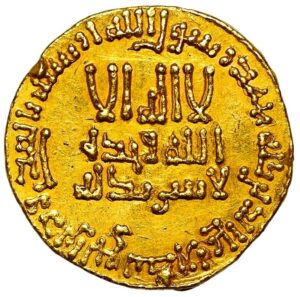
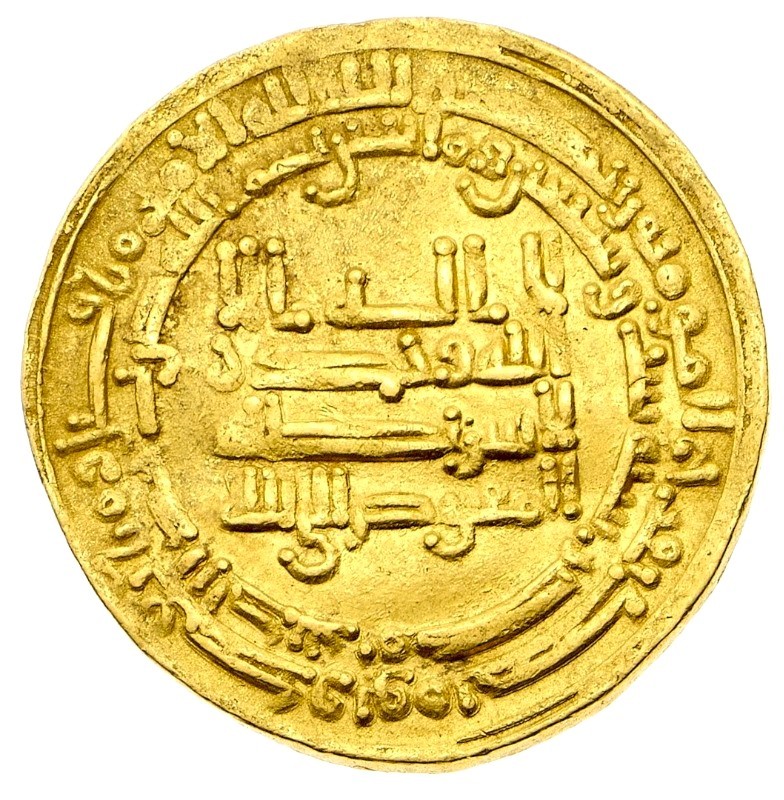
One of the most distinctive characteristics of Abbasid gold dinars is their calligraphic design. Instead of presenting a ruler’s portrait, these coins generally feature Arabic inscriptions arranged in concentric circles and horizontal lines across both sides. The inscriptions commonly include the Islamic declaration of faith, references to the oneness of God and Qur’anic text. Many issues also record the mint and the year according to the Islamic Hijri calendar.
The inscriptions are historical evidence in their own right. They communicate religious principles, demonstrate the use of Arabic as a language of government and commerce, and help researchers identify individual issues. Dates and mint names are particularly valuable because they allow specialists to place a coin within a specific period of Abbasid rule.
The Hijri calendar, which begins with the Prophet Muhammad‘s migration from Mecca to Medina in 622 AD, differs from the Gregorian calendar. Converting a coin’s Hijri date into a Gregorian date requires care because Islamic lunar years are shorter than solar years. Consequently, a Hijri year can overlap two Gregorian years. Accurate dating should therefore be based on specialist conversion tables and the coin’s complete inscription.
For researchers studying Abbasid gold dinars struck in Palestine, these details provide a foundation for distinguishing individual mint issues, identifying chronological developments and comparing examples held in museums, archaeological collections and private ownership.
The Abbasid gold dinar operated within a sophisticated monetary environment that included gold dinars, silver dirhams and copper fulus. Each denomination served different economic purposes, while exchange rates and actual purchasing power varied according to location, period, market conditions and the quality of the coinage.
Gold was especially important in high-value commerce and long-distance trade. Palestine’s geographical position linked the eastern Mediterranean with Egypt and the wider Islamic world, creating opportunities for the movement of commodities, merchants and precious metals. Gold dinars could cross political and regional boundaries, making them material witnesses to the interconnected economies of the medieval period.
The economic importance of these coins should not be confused with modern investment performance. An ancient gold dinar possesses a bullion component, but its market value may also depend on rarity, historical importance, condition, weight, authenticity, provenance and collector or investor demand. A common Abbasid issue and a rare, well-preserved dinar bearing an unusual mint designation can command substantially different prices even when their gold contents are comparable.
For investors interested in tangible historical assets, Abbasid gold dinars consequently occupy a distinctive category between precious-metal ownership and historical numismatic investment. Their appeal lies in the combination of material value and documented cultural significance, although market prices can fluctuate and future returns are never guaranteed.
Authentication is fundamental when evaluating Abbasid gold dinars, particularly examples attributed to Palestine. Specialists assess weight, diameter, die characteristics, calligraphy, metal composition, surface condition and consistency with documented examples. They also examine signs of modern tooling, imitation, casting or other alterations that may affect authenticity and value.
Condition terminology must be interpreted carefully. A coin described as Extremely Fine, for example, should display characteristics consistent with recognised numismatic grading conventions. Original lustre, strike quality, wear and surface preservation may influence desirability, but grading can vary between specialists and markets. Independent expert assessment is especially valuable when purchasing a rare or expensive issue.
Provenance is another important consideration. Records of previous ownership, old auction appearances, published references and relevant documentation can help establish a coin’s history. Buyers should also consider applicable cultural-property, import, export and trade regulations. Historical age alone does not guarantee unrestricted international movement or sale, and legal requirements depend on the jurisdictions involved and the circumstances of the transaction.
Responsible acquisition protects both the buyer and the historical record. Coins should be handled carefully, stored in suitable conditions and never cleaned aggressively, as inappropriate cleaning can damage original surfaces and diminish numismatic value.
Abbasid gold dinars associated with Palestine are far more than surviving pieces of precious metal. Properly attributed examples preserve evidence of Islamic political authority, Arabic epigraphy, medieval trade, provincial administration and the monetary relationships that connected the eastern Mediterranean with the wider Islamic world. Their inscriptions transform each coin into a compact historical document, recording elements of religious identity, chronology and monetary authority in a form that has survived for more than a millennium.
For historians and investors alike, the most compelling examples combine verifiable authenticity, clear mint attribution, meaningful historical context, strong preservation and credible provenance. A coin explicitly naming a Palestinian mint carries a different historical claim from one merely discovered in Palestine, and that distinction should always be reflected in professional descriptions.
The study of Abbasid gold dinars struck in Palestine therefore offers a valuable intersection of Islamic history, ancient gold coinage, medieval economics and tangible cultural heritage. Through careful research and responsible ownership, these extraordinary coins continue to illuminate the sophistication of the Abbasid world and preserve a lasting connection to one of the most influential civilisations of the medieval era.
@Main poster from Fincyclopedia.