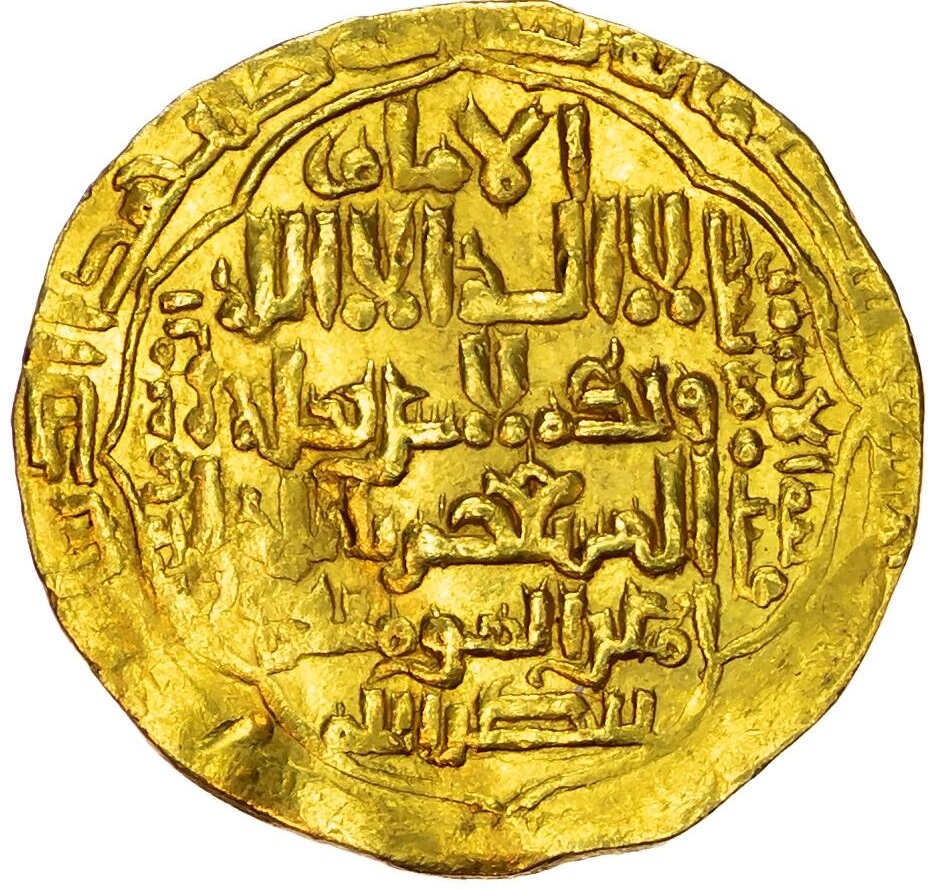
Ancient Islamic gold coins represent one of the most important monetary traditions in world history. From the emergence of the early Islamic caliphates to the sophisticated coinages of the Umayyad, Abbasid, Fatimid, Ayyubid, Mamluk and later Islamic dynasties, gold coins served not merely as currency but also as instruments of sovereignty, religious expression, political communication and international commerce. Today, ancient Islamic gold coins, particularly gold dinars, are highly significant historical assets because their inscriptions, mint names, dates and calligraphic styles can provide remarkably precise information about the rulers and societies that produced them.
For investors in historic precious metals, understanding the classification of Islamic gold coins is essential. Unlike many modern coins, Islamic coins frequently contain little or no portraiture. Their identity is instead established through Arabic inscriptions, Qur’anic quotations, religious declarations, ruler names, mint designations and dates. This makes Islamic numismatics a specialized field in which reading and interpreting inscriptions is often more important than simply examining the visual design. A properly classified Islamic gold dinar can therefore reveal its dynasty, ruler, mint, approximate production date and historical context, transforming a small piece of gold into a primary historical document.
The dinar became the principal gold denomination of the Islamic monetary world. The word itself has roots in the Roman denarius aureus and Byzantine solidus, reflecting the monetary traditions that existed across the Middle East and Mediterranean before and during the rise of Islam. The earliest Islamic gold coinage initially retained significant Byzantine influence, but Islamic rulers progressively developed a distinct monetary identity.
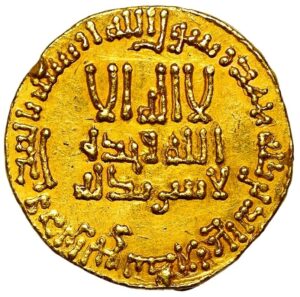
The most important transformation occurred under the Umayyad Caliph Abd al-Malik ibn Marwan, whose monetary reforms in the late seventh century AD established the classic Islamic gold dinar. The reformed dinar abandoned Byzantine-style imperial imagery and introduced an entirely epigraphic design based on Arabic inscriptions. This development was revolutionary in the history of Islamic coinage.
The Islamic gold dinar generally contains a central inscription surrounded by additional legends. Rather than depicting a king, emperor or deity, the coin communicates authority through written language. Religious statements affirming the oneness of God and the prophethood of Muhammad became central elements of the design.
Consequently, classification begins with the inscription, not merely the appearance of the coin.
A useful classification system begins with the dynasty or political authority responsible for issuing the coin. Each dynasty developed distinctive monetary traditions, weights, inscriptions, calligraphy and mint systems.
The Umayyad gold dinar is among the most historically important Islamic coins. The great monetary reform of Abd al-Malik around 77 AH (696–697 AD) produced the archetypal Islamic dinar.
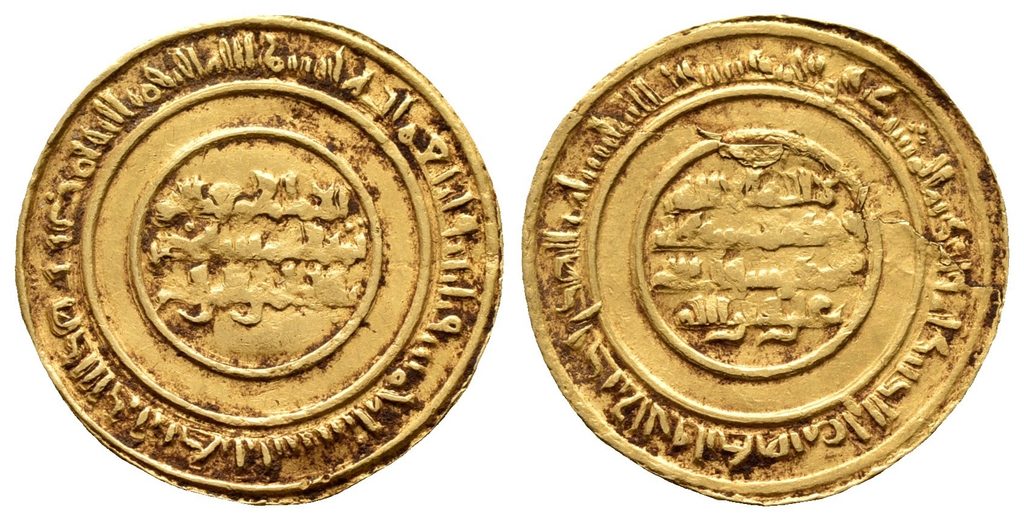
These coins are generally characterized by elegant Arabic inscriptions arranged within concentric borders. The obverse commonly carries the Islamic declaration of faith and religious formulas, while the reverse contains Qur’anic text, particularly passages associated with the oneness of God and the role of Muhammad.
The absence of portraits is one of the defining characteristics of the reformed Umayyad dinar. This makes it immediately distinguishable from many earlier Byzantine and contemporary European gold coins.
Following the Umayyad dynasty, the Abbasid Caliphate introduced its own extensive gold coinage. Abbasid gold dinars were struck across a vast territory extending from North Africa and the Middle East toward Central Asia.
Abbasid coin classification can be considerably more complex because the coins frequently identify the caliph, mint and date, while some issues also mention additional authorities. Changes in calligraphy and inscription arrangement can assist specialists in identifying particular periods.
The Abbasid monetary system demonstrates the importance of the dinar in long-distance commerce. Abbasid silver dirhams became especially prominent in international trade, including Viking-era commerce, while gold dinars occupied an important role in high-value transactions and state finance.
A properly identified Abbasid gold dinar can therefore offer information not only about Islamic monetary history but also about the commercial networks connecting the Middle East, North Africa, Central Asia and Europe.
The Fatimid gold dinar represents one of the most sophisticated traditions in medieval Islamic numismatics. The Fatimid Caliphate ruled significant territories in North Africa, Egypt, the Levant and parts of the Mediterranean world.
Fatimid gold coins are particularly important because Cairo and other Fatimid mints produced substantial quantities of high-quality gold coinage. The inscriptions frequently contain the names and titles of Fatimid rulers together with religious formulas reflecting Ismaili Shi’a ideology.
The reign of Al-Mustansir Billah is especially notable for its extensive gold coinage. Fatimid dinars can often be classified through a combination of ruler name, date, mint and inscription arrangement.
For advanced Islamic coin investors, a Fatimid gold dinar is particularly interesting because the coin can simultaneously represent precious-metal value, medieval Egyptian history, Islamic art, Arabic calligraphy and dynastic history.
The Ayyubid dynasty, founded by Salah al-Din (Saladin), produced a diverse range of Islamic coinage. Ayyubid gold coins belong to a period of major political and military transformation in the Middle East.
Classification of Ayyubid gold coinage can require careful analysis because different rulers and regional authorities issued coins with varying combinations of titles, inscriptions and mint information.
Ayyubid coins can therefore be particularly valuable to historians because they provide evidence of political authority and changing relationships between regional rulers and the wider Islamic world.
The Mamluk Sultanate developed an important gold coinage system centered largely on Egypt and Syria. Mamluk gold coins are generally more complicated to classify than the earliest Umayyad issues because of the number of rulers, titles and changing monetary standards.
The gold dinar, or later gold denominations associated with Mamluk monetary practice, can feature the sultan’s titles, mint names and dates. Understanding Mamluk coinage therefore requires familiarity with Arabic titulature and the political history of the period.
For specialists, these coins are especially valuable because the inscriptions can establish a direct connection between a physical gold object and a specific historical ruler.
When examining an ancient Islamic gold coin, five elements should be considered together.
Ruler: The name of the caliph, sultan or other issuing authority is often the primary classification key.
Mint: The location where the coin was struck is extremely important. Famous Islamic mints included Damascus, Wasit, Baghdad, Cairo, Misr, Madinat al-Salam and numerous regional centers.
Date: Islamic coins commonly use the Hijri calendar, identified by AH. Converting the date into AD provides an additional chronological reference. For example, AH 437 corresponds to 1045 AD.
Inscription: Arabic legends frequently contain religious declarations, Qur’anic passages, ruler names, titles and administrative information.
Weight and gold standard: The weight of a coin can help distinguish denominations and monetary reforms, although weight alone should never be used to authenticate an ancient gold coin.
Together, these characteristics form the foundation of Islamic coin identification.
The greatest challenge for newcomers to Islamic numismatics is learning how to interpret Arabic inscriptions. Unlike portrait coins, where the ruler can sometimes be identified visually, Islamic gold coins often require the reader to understand the text.
The first step is determining whether the inscription contains a religious formula, a ruler’s name, a mint name or a date. Specialists then compare the style and arrangement with established numismatic references.
Calligraphy itself is also informative. Changes in Arabic script, spacing, inscription layout and decorative borders can help distinguish different periods.
The inscription should therefore be regarded as the coin’s historical fingerprint.
Ancient Islamic gold coins were generally produced according to established monetary standards, but actual weights and gold content can vary because of circulation, clipping, manufacturing tolerances and later damage.
A genuine ancient gold dinar should therefore be evaluated using multiple characteristics rather than weight alone.
Important examination points include:
Professional authentication can include metallurgical analysis, die comparison and examination under magnification.
This is particularly important because ancient Islamic gold coins are heavily reproduced and imitated. A visually convincing coin should not automatically be considered authentic.
The mint and date can dramatically influence the historical importance of an Islamic gold coin.
Two coins struck by the same ruler can have very different historical significance depending on where and when they were produced. A coin from an important political center may document the economic reach of a dynasty, while a rare provincial mint may provide evidence of regional administration.
Similarly, a coin produced during a major political transition can be especially significant because it may document a change in sovereignty.
For this reason, experienced Islamic numismatists rarely describe a coin simply as an “ancient Islamic gold coin.” A complete classification attempts to identify dynasty, ruler, denomination, mint, date and inscription type.
Perhaps the most remarkable characteristic of Islamic gold coins is their ability to function as miniature historical documents.
A single gold dinar can preserve the name of a ruler who governed more than a thousand years ago. It can identify a medieval mint, establish a chronological date and reveal the religious and political language used by a government.
In this sense, ancient Islamic gold coins belong simultaneously to the worlds of numismatics, archaeology, Islamic history, economic history, calligraphy and precious-metal investment.
The physical gold is only one component of their significance. Their historical information can be equally important.
The market for rare Islamic gold coins is highly specialized. Value can depend on gold weight, rarity, historical importance, condition, artistic quality, provenance, denomination, mint, ruler and demand among sophisticated investors.
A common Islamic gold dinar may trade primarily according to its historical and precious-metal characteristics, whereas a rare mint, unusual date or historically important issue can command a substantial premium.
Investors should also distinguish between gold bullion value and numismatic value. A gold coin’s melt value provides a baseline based on its precious-metal content, while its historical scarcity and desirability may create an additional numismatic premium.
Provenance and documentation can also be important. Records demonstrating previous ownership, professional attribution or publication history can strengthen confidence in an important ancient Islamic coin.
For anyone studying Islamic gold coinage, a practical classification framework can be summarized as:
Dynasty → Ruler → Denomination → Mint → Hijri Date → Inscription → Weight → Historical Context.
This sequence provides a reliable foundation for researching an Islamic gold coin.
For example, a classification might identify a coin as a Fatimid Gold Dinar of Al-Mustansir Billah, struck at Misr in AH 437 (1045 AD). Each component adds another layer of information: the dynasty identifies the political authority, the ruler identifies the sovereign, the denomination identifies the monetary unit, the mint identifies the place of production and the Hijri date establishes chronology.
That level of classification transforms a generic description into a professional numismatic attribution.
Ancient Islamic gold coins are among the most extraordinary surviving objects of medieval monetary history. From the revolutionary Umayyad gold dinars of the seventh century AD to the sophisticated Abbasid, Fatimid, Ayyubid and Mamluk coinages that followed, these coins document the development of Islamic civilization through gold, language and historical memory.
The key to understanding them is classification. Ruler, mint, date, inscription, denomination, weight and historical context form the essential framework through which an Islamic gold coin can be identified and understood.
For investors seeking historically significant precious-metal assets, an authenticated ancient Islamic gold coin represents far more than its intrinsic gold content. It can embody the legacy of a dynasty, the authority of a forgotten ruler, the artistry of Arabic calligraphy and the economic history of an entire civilization. Proper classification allows that story to be preserved—and allows each remarkable gold dinar to be understood not simply as an old coin, but as a tangible fragment of Islamic history.