CEO of House of Emirates®
The history of ancient Jewish coinage is a remarkable story of commerce, religious identity, political sovereignty and resistance. From the small bronze prutah that circulated through the marketplaces of ancient Judaea to the monumental silver shekel issued during the First Jewish Revolt against Rome, these coins preserve tangible evidence of Jewish life across more than two millennia. Their inscriptions, symbols, metals and minting techniques reveal how money functioned in everyday transactions, how rulers expressed authority, and how a people sought to preserve its identity under successive empires.
The Jewish prutah coin and the ancient Jewish silver shekel represent two distinct but interconnected chapters in this history. The prutah became one of the most familiar low-denomination coins of Judaea, used for ordinary purchases and small payments. The silver shekel, particularly the shekels struck during the Jewish revolt beginning in AD 66, represented something more ambitious: the declaration of national identity and an assertion of independence through the creation of a distinctive monetary system. Understanding these coins requires examining their origins, historical context, practical uses, religious symbolism and significance to modern archaeology and ancient coin collecting.
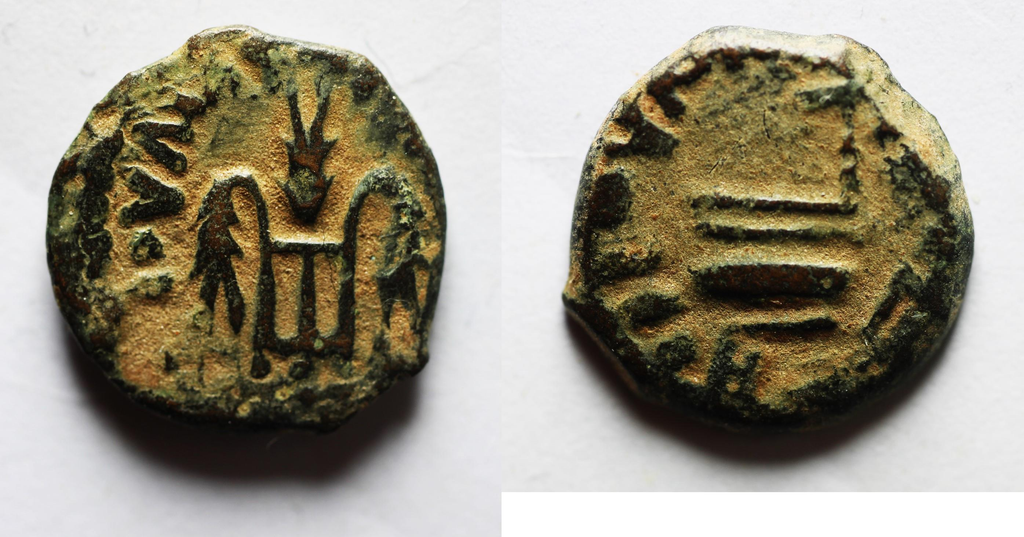
The prutah, also transliterated as perutah, was a small bronze or copper-alloy denomination associated with ancient Jewish and Judaean monetary history. Its importance arose not from its intrinsic metal value but from its widespread use in daily economic life. Small coins facilitated the purchase of food, household necessities and other inexpensive goods, making them an essential component of local commerce.
The origins of Jewish coinage, however, predate the familiar Hasmonean prutah. Small silver coins were produced in the Persian-period province of Yehud during the fourth century BC, bearing inscriptions associated with the province and sometimes the names of officials. These early issues demonstrate that coin production in Judaea began under foreign imperial administration, rather than with the establishment of an independent Jewish kingdom.
A significant transformation occurred under the Hasmonean dynasty, which emerged from the Jewish revolt against Seleucid rule in the second century BC. Following the Maccabean struggle and the gradual establishment of Hasmonean authority, Jewish rulers began issuing their own coins. John Hyrcanus I, who ruled approximately 135–104 BC, is among the earliest securely attested Hasmonean authorities associated with an extensive indigenous coinage tradition.
Unlike the precious-metal coinage of some neighbouring kingdoms, Hasmonean coins were predominantly bronze. Their modest denominations served practical economic needs while their designs expressed local authority and identity. This combination of ordinary utility and political meaning made the Hasmonean prutah one of the most historically significant small coins of the ancient Jewish world.
The distinction is important: the first Jewish coins, the first coins issued by a Jewish government in Jerusalem, and the first distinctive silver coins of the Jewish revolt are not the same historical milestone. Each belongs to a different phase in the evolution of Jewish money.
One of the defining characteristics of ancient Jewish coinage was its distinctive visual language. Many Jewish and Judaean coins avoided human and animal portraits, favouring botanical motifs, ritual objects and inscriptions. These choices reflected religious sensitivities and provided an alternative to the portrait-heavy coinage commonly encountered in the Hellenistic and Roman worlds. American Numismatic Society+1
The prutah issued by John Hyrcanus I provides an excellent example. One side features a double cornucopia, a symbol of abundance inherited from the wider Hellenistic artistic tradition, with a pomegranate between its curved horns. The opposite side bears an inscription in ancient Hebrew script enclosed by a wreath. The inscription identifies the ruler as Yehohanan, or John, the high priest, and refers to the Jewish community or council. collections.thejewishmuseum.org+1
The pomegranate is particularly significant in the historical interpretation of Jewish coins. Its association with biblical descriptions of Temple decoration and priestly garments makes it a meaningful emblem within ancient Judaean visual culture. The double cornucopia, meanwhile, demonstrates that Jewish coinage did not develop in isolation: local authorities adapted familiar Mediterranean imagery to communicate their own political and cultural identity.
Later prutot introduced other designs, including palm branches, wreaths, lilies, amphorae and inscriptions connected with ruling authorities. During the Roman administration of Judaea, coins bearing the names of emperors or dates associated with imperial reigns circulated alongside Jewish religious and commercial life. Their designs were often selected to avoid imagery considered objectionable to the local population. ruj.uj.edu.pl+2
These features make the ancient Jewish prutah more than a simple monetary object. Its imagery offers evidence of the relationship between religion, government, economic life and cultural identity in the ancient Near East.
The prutah served as a small denomination in the monetary economy of ancient Judaea. Its practical value lay in facilitating transactions that did not require larger silver or gold coins. Bronze and copper-alloy currency was particularly suitable for local circulation, where ordinary people needed convenient means of exchanging modest amounts of money.
A merchant selling produce, a customer purchasing household goods or a traveller making a small payment could use low-value coins within a wider economy that also employed larger denominations. The prutah therefore provides an important connection between the political history of ancient Judaea and the ordinary experiences of the people who lived there.
The precise purchasing power of an individual prutah varied according to period and circumstances. It would be misleading to assign it a single modern monetary equivalent, because ancient prices, wages, coin weights and monetary conventions differed considerably from modern systems.
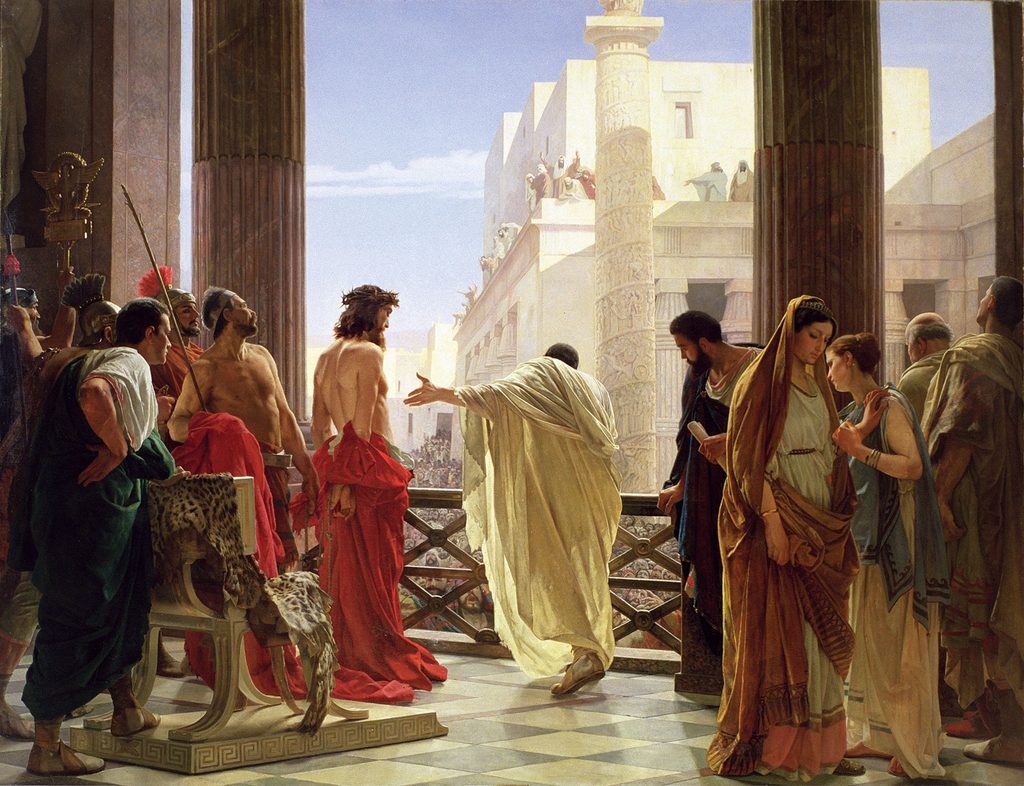
Prutot also circulated during the first century AD, including under Roman governors and Herodian rulers. Coins associated with Pontius Pilate, who governed Judaea from AD 26 to 36, are among the most recognisable examples of Roman-period Judaean bronze currency. Such coins are particularly important to historical research because their inscriptions, dates and archaeological contexts help scholars reconstruct the political chronology of the region.
During the First Jewish Revolt against Rome, Jewish authorities continued producing bronze coins, including small denominations bearing messages associated with the struggle for independence. These issues demonstrate that the prutah tradition persisted even as the political circumstances of Judaea changed dramatically.
The Jewish silver shekel occupies a particularly important place in the history of ancient coinage. Yet its origins require a historical distinction: Jewish communities had already produced small silver coins during the Persian period, centuries earlier. The silver shekels struck during the First Jewish Revolt are celebrated as the first distinctive Jewish silver shekels issued in the name of an independent Jewish revolutionary authority, rather than the first silver coins ever produced by Jews.
The revolt began in AD 66, amid mounting tensions between the Jewish population and Roman imperial administration. As the conflict developed, control of Jerusalem and its Temple became central to the struggle. The rebel authorities began striking their own silver and bronze coinage, transforming money into an explicit declaration of political resistance.
Before the revolt, silver Tyrian shekels had played an important role in the payment of the annual Temple tax. Their consistent silver content made them suitable for this religious obligation. When the conflict disrupted established monetary arrangements, the production of Jewish silver shekels provided an alternative and expressed a new political ambition. The precise circumstances of the early minting remain a subject of historical discussion, but the connection between Temple finance, silver currency and the revolt is well established.
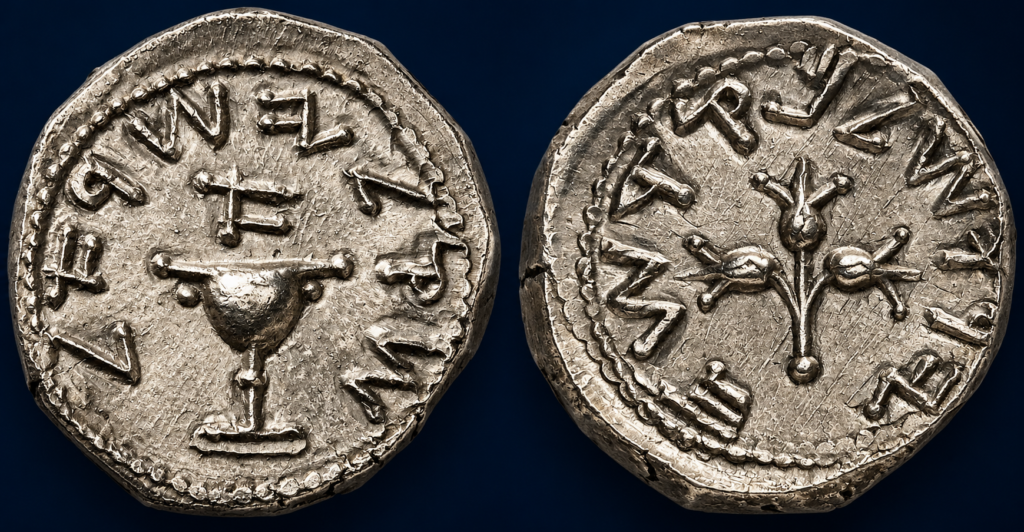
The first-year silver shekel, dated AD 66–67, is among the most recognisable examples of this remarkable series. According to the British Museum, a representative example measures approximately 22 millimetres in diameter and weighs 14.15 grams. Individual surviving coins vary, and their condition and weight depend on the specimen.
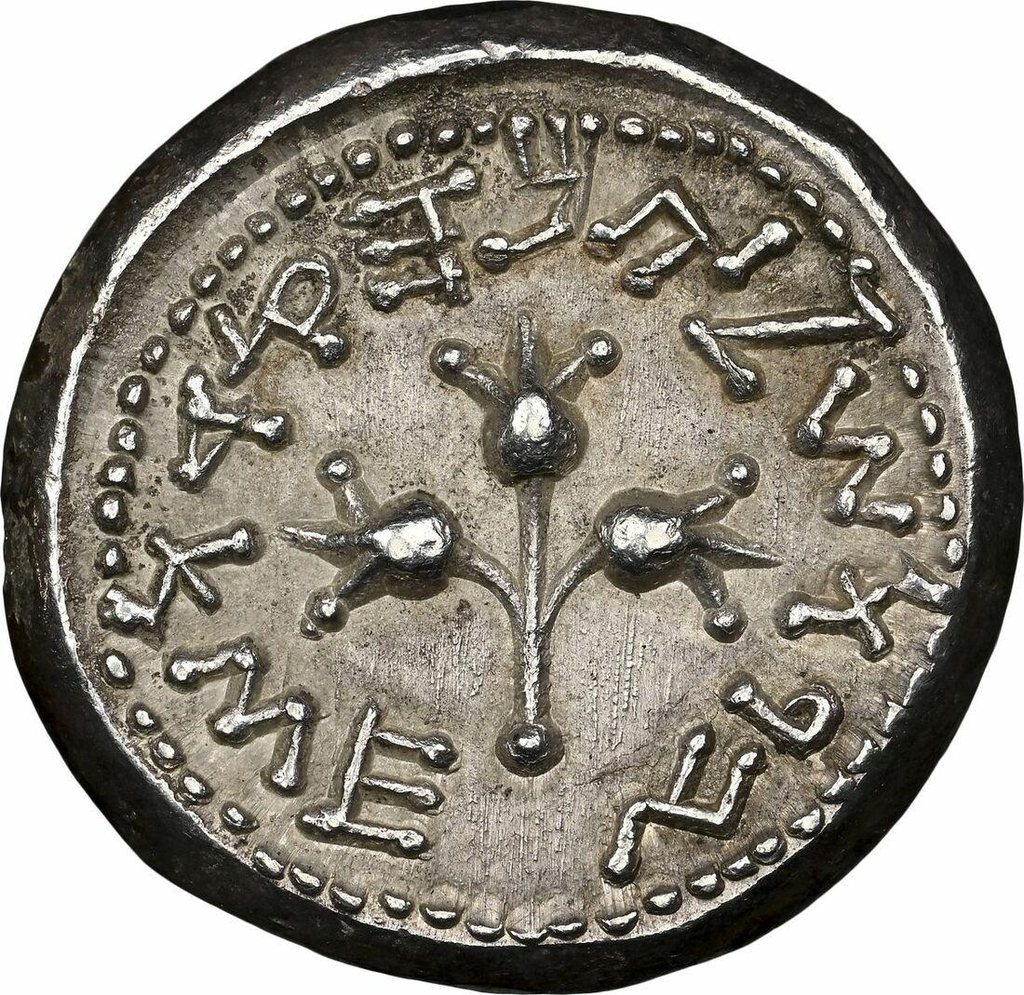
The obverse depicts a ceremonial chalice, commonly interpreted as a Temple-related ritual vessel, accompanied by an inscription meaning “Shekel of Israel.” The reverse displays a stem bearing three pomegranate forms and the inscription “Jerusalem the Holy.” These legends are central to the coin’s historical significance.
The language and symbolism were deliberate. Rather than relying on imperial portraits or Greek and Latin political formulas, the silver shekel used ancient Hebrew script and references to Israel and Jerusalem. The design presented a vision of Jewish national identity rooted in religious tradition and the authority of the holy city.
Minting a coin is not simply a technical or commercial activity. It demonstrates an authority’s capacity to organise production, establish monetary standards and circulate an officially recognised means of payment. In the Roman imperial system, the issue of precious-metal coinage was closely connected with imperial authority. The appearance of distinctive Jewish silver shekels during the revolt therefore carried exceptional political weight.
The inscriptions did not merely identify a denomination. They announced the issuing community’s claim to authority and associated that claim with Jerusalem and Israel. The silver shekel consequently became a monetary expression of resistance, sovereignty and religious continuity.
The series included shekels, half-shekels and, in limited instances, quarter-shekels. Year markings linked the coins to the successive years of the conflict. The early issues are especially important because they show how the rebels established a new monetary identity at the beginning of their struggle.
The pomegranate motif on the reverse reinforces this connection between money and tradition. Its associations with biblical imagery and the Temple made it an appropriate symbol for a coin that invoked the sacred status of Jerusalem. The chalice on the obverse similarly connected the currency with ritual and Temple life.
The Jewish silver shekel thus stands at the intersection of ancient economics, Jewish religious history, Roman imperial politics and the history of national symbolism. Few surviving coins communicate so clearly the political aspirations of the authority that issued them.
The First Jewish Revolt continued until AD 70, when Roman forces captured Jerusalem and destroyed the Second Temple. Resistance persisted at other locations, including Masada, until the final stages of the conflict. The defeat brought the end of the revolutionary coinage programme associated with the revolt.
As the war progressed, the rebels also issued bronze denominations with inscriptions expressing freedom and the redemption of Zion. These coins provide a complementary perspective on the silver shekel: whereas silver communicated a formal monetary claim through a substantial denomination, bronze currency carried related political messages into everyday circulation.
Jewish coins production later resumed during the Bar Kokhba Revolt of AD 132–135. Coins from that uprising featured designs including the Jerusalem Temple, ritual plants and inscriptions invoking freedom. Some were struck by overstriking existing Roman coins, an act that visibly replaced imperial imagery with symbols of the rebellion.
The later series should not be confused with the first Jewish silver shekel of AD 66–67. The two belong to different revolts, separated by more than six decades, but both reveal the continued use of coinage as a medium for expressing Jewish identity and political aspiration.
Today, ancient Jewish coins are studied by historians, archaeologists and numismatists seeking to understand the economic and political history of Judaea. Their value to scholarship extends beyond their appearance or metal content. Coin inscriptions, minting techniques, archaeological locations and links to historically dated events can help establish chronologies and clarify the development of ancient communities.
The prutah is particularly valuable for studying everyday life. Because these small bronze coins circulated widely, surviving examples can help researchers investigate local commerce, administrative practices and the chronology of archaeological sites. Scientific analysis of the metal composition of certain prutot has also helped researchers investigate their production and historical attribution.
The silver shekel offers a different kind of historical evidence. Its inscriptions, denomination, silver composition and distinctive designs provide direct testimony to the monetary ambitions of the First Jewish Revolt. Surviving examples are preserved in major museum collections, including the British Museum, where documented specimens allow researchers and the public to examine the physical evidence of this turbulent period.
For those interested in ancient Jewish coins, biblical coins, Judaean numismatics and the history of the Second Temple period, these objects offer an unusually tangible connection with antiquity. Every surviving coin has its own physical history, and responsible study requires attention to authenticity, provenance, condition, attribution and the evidence supporting its date.
The ancient Jewish prutah and the silver shekel embody two complementary dimensions of Jewish monetary history. The prutah represents the practical foundations of daily economic life, circulating among ordinary people under changing local and imperial authorities. The silver shekel of AD 66–67 represents a more dramatic transformation: the emergence of a distinctive Jewish silver denomination during a struggle for political independence.
Their historical importance lies in the relationship between function and meaning. These were instruments of exchange, but they were also expressions of authority, religious tradition and cultural identity. The pomegranate, ceremonial chalice, ancient Hebrew inscriptions and references to Jerusalem reveal how coinage could communicate ideas that extended far beyond monetary value.
For modern historians and numismatists, the Jewish prutah and the ancient silver shekel remain indispensable witnesses to the past. They preserve evidence of commerce, government, religious practice and resistance, connecting the marketplaces of ancient Judaea with the wider history of the Jewish people and the ancient Mediterranean world.