
£6,000.00
Umayyad Gold Dinar AH 100 (AD 718/9) – Caliph Umar ibn Abd al-Aziz | Islamic Gold Coin
House of Emirates® in London is thrilled to offer its elite clientele this majestic Umayyad gold dinar, an extraordinary testament to the formative centuries of Islamic civilisation and the enduring legacy of one of the most respected rulers of the Umayyad Caliphate, Caliph Umar ibn Abd al-Aziz. Struck in 100 AH (AD 718/9), this remarkable early Islamic gold coin represents an era when the Islamic world was consolidating its political institutions, expanding its commercial networks and establishing a distinctive monetary identity that would influence international trade for centuries.
Weighing 4.28 grams and measuring 20 mm in diameter, this historic Islamic gold dinar combines precious-metal value, exceptional historical significance and the refined artistic language of early Islamic numismatics. With an attractive grade of About Extremely Fine, it offers a compelling opportunity for discerning investors seeking authentic ancient gold coins with a profound connection to world history.
Umar ibn Abd al-Aziz, who ruled from 717 AD to 720 AD, occupies a distinctive position in Islamic history. Frequently remembered for his reputation for justice, personal austerity and administrative reform, he is often regarded as one of the most exemplary Umayyad caliphs. His reign came at a pivotal moment when the Islamic empire governed extensive territories stretching across the Middle East, North Africa and beyond. Gold dinars served as a fundamental instrument of this vast economic system, facilitating taxation, long-distance commerce and transactions between merchants operating across different regions.
The year AH 100 (AD 718/9) places this coin within the early decades of the Islamic monetary tradition established following the monetary reforms of Caliph Abd al-Malik ibn Marwan in the late seventh century. These reforms introduced a distinctive Islamic gold dinar that moved away from earlier Byzantine-inspired imagery towards inscriptions expressing Islamic religious identity. The result was a powerful and enduring monetary design in which Arabic calligraphy, Qur’anic verses and carefully structured inscriptions replaced imperial portraits and figurative representations. This transformation made the Umayyad dinar not merely a means of payment but also a tangible expression of a new civilisation’s religious, political and economic identity.
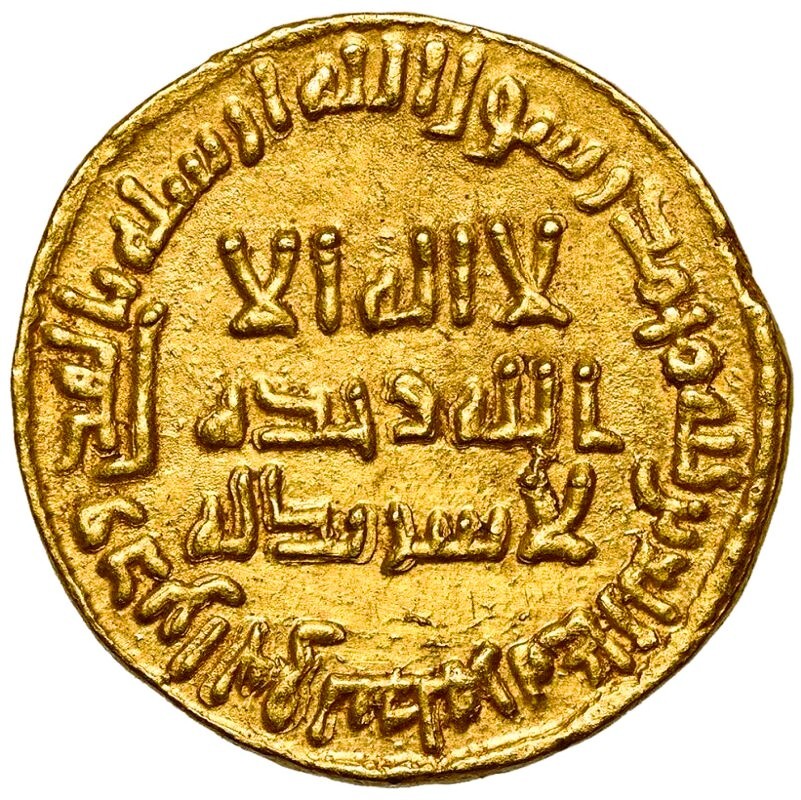
The obverse features the opening portion of the Islamic declaration of faith, the Kalima, arranged in three horizontal lines across the central field. Encircling the inscription is a Qur’anic legend associated with Surah IX, verse 33, affirming the divine mission of Islam. This carefully organised composition exemplifies the sophisticated epigraphic style that characterises early Islamic gold coinage.
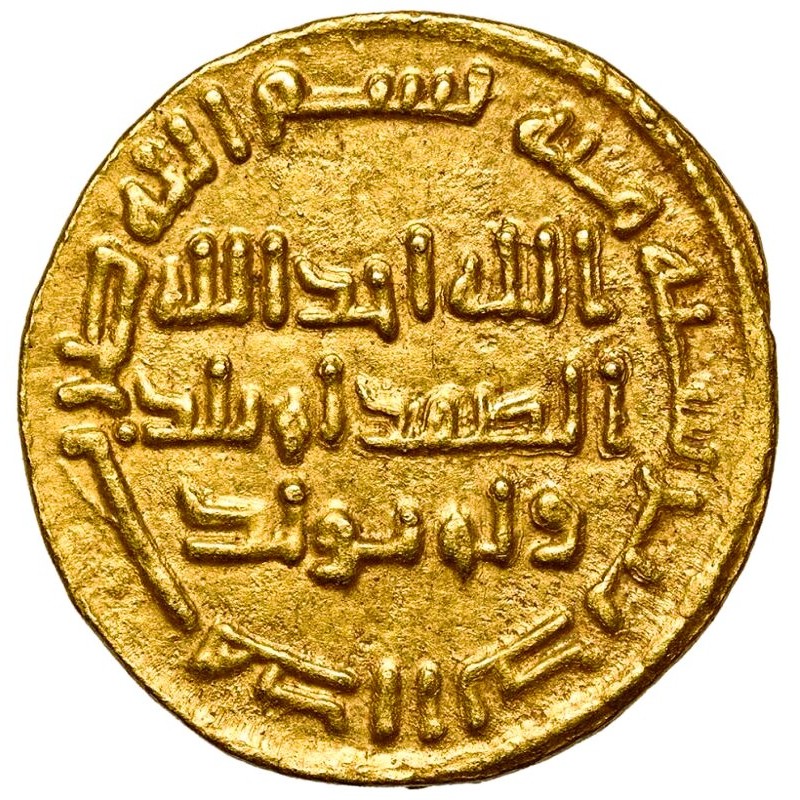
The reverse presents an inscription from Surah CXII, Al-Ikhlas, arranged in three lines within the central field, accompanied by the surrounding date formula. This chapter expresses the absolute oneness and uniqueness of God, making it particularly significant within Islamic religious tradition. The deliberate use of sacred inscriptions gives the coin a distinctive visual identity, in which calligraphy serves simultaneously as religious expression, artistic ornament and a declaration of authority.
The mint is not explicitly named, as is consistent with certain early Islamic dinar issues. Damascus (Dimashq) has been suggested as a possible mint attribution, although this remains uncertain. This distinction is important when assessing the coin: its documented attribution to the Umayyad monetary tradition is clear, while the precise mint should be regarded as a qualified possibility rather than an established fact.
Early Islamic gold dinars are valued for their combination of precious-metal content, historical importance and enduring relevance to the study of the medieval world. Coins struck during the reign of Umar ibn Abd al-Aziz are particularly compelling because they connect the owner with a caliph whose reputation has endured well beyond his brief period in power. The year 100 AH also offers a clear chronological anchor within the early development of Islamic gold coinage.
The present specimen’s About Extremely Fine grade indicates an attractive level of preservation for a historic gold coin of this period. Its legible inscriptions, substantial gold fabric and recognisable design make it a noteworthy addition to a portfolio of ancient gold coins, early Islamic numismatic rarities and tangible historical assets.
For investors considering tangible luxury assets, ancient gold coins can offer an alternative dimension to conventional holdings. Unlike contemporary bullion, a historic dinar carries an additional layer of cultural significance that cannot be measured by gold weight alone. Its value may reflect condition, authenticity, historical attribution, market demand and provenance alongside the underlying precious metal. As with all numismatic investments, prices can fluctuate, liquidity is not guaranteed, and careful authentication and independent valuation remain essential.
This Umayyad gold dinar of 100 AH (AD 718/9) represents a remarkable intersection of Islamic heritage, early monetary history and enduring gold craftsmanship. Associated with the reign of Umar ibn Abd al-Aziz, it offers discerning investors the opportunity to own an authentic piece of a formative period in world civilisation. Its historical inscriptions, attractive preservation and substantial gold composition distinguish it from ordinary modern bullion, giving it a unique place within the world of ancient Islamic gold coins.
Historical Specifications


