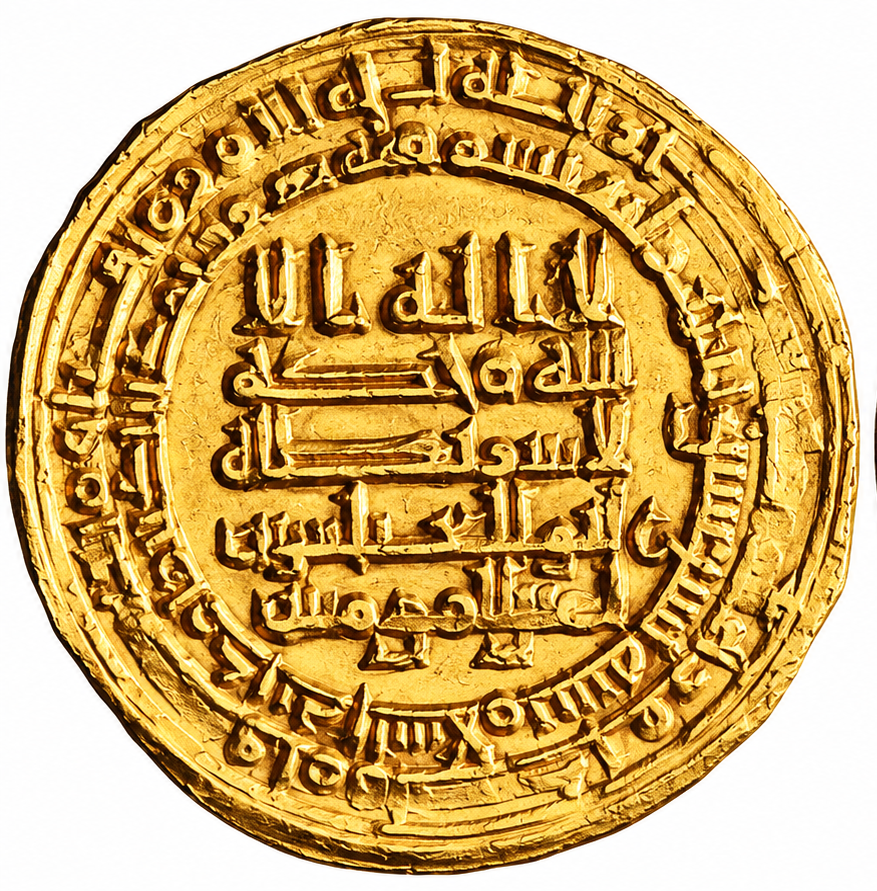
The Abbasid gold dinar stands among the most historically significant gold coins of the medieval Islamic world. Struck under the Abbasid Caliphate from the 8th century onward, these coins were not merely instruments of commerce: they were official declarations of sovereignty, faith, political legitimacy, and economic power. For historians, numismatists, and investors in historic monetary artifacts, Abbasid dinars offer a remarkable window into one of the most influential civilizations of the medieval Middle East.
The Abbasid Caliphate came to power in 132 AH (750 AD) after overthrowing the Umayyad dynasty. Its rise transformed the political center of the Islamic world. Baghdad eventually became the great capital of the caliphate, while Abbasid authority extended across vast territories of the Middle East, North Africa, Central Asia and, at various times, other regions. Gold coinage played an important role in this system. The Abbasid dinar inherited the fundamental monetary standards established under earlier Islamic rulers while developing distinctive inscriptions, minting practices and historical characteristics of its own.
An Abbasid gold dinar is a gold coin issued under one of the Abbasid caliphs. The term dinar derives ultimately from the Roman denarius, but by the early Islamic period it had become the principal gold monetary denomination of the Islamic world.
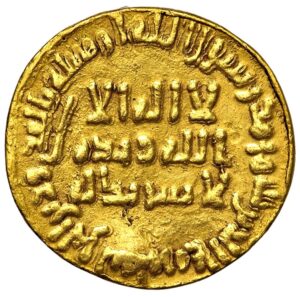
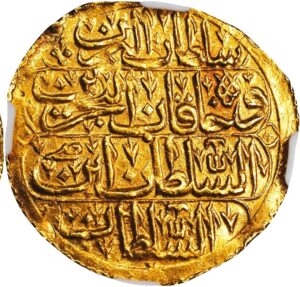
The classic Islamic dinar was approximately 20–22 mm in diameter and traditionally weighed around 4.25 grams, although surviving specimens vary because of historical minting tolerances, clipping, wear and other factors. Unlike many ancient and medieval coins, Abbasid dinars generally do not feature portraits of rulers. Instead, their surfaces are dominated by Arabic inscriptions arranged in carefully designed fields and legends.
This absence of royal portraiture is one of the most distinctive characteristics of Islamic coinage. The inscriptions communicate religious declarations, the authority of the caliph, the date of issue and often the mint. Consequently, understanding an Abbasid dinar requires reading the coin as a historical document as much as examining it as a physical object.
The Abbasid seized power in 132 AH (750 AD), bringing an end to Umayyad rule in most of the Islamic world. The first Abbasid caliph, Abu al-Abbas al-Saffah, ruled only briefly, followed by his successor Abu Ja’far al-Mansur, who became one of the most consequential rulers in early Abbasid history.
Al-Mansur founded Baghdad in 145 AH (762 AD), establishing a new political and intellectual center that would eventually become synonymous with the Golden Age of the Abbasid world.
Early Abbasid gold dinars retained much of the established Islamic monetary tradition. This continuity was important: a stable gold currency facilitated taxation, long-distance trade and confidence in the monetary system. Yet the inscriptions and minting patterns evolved over time, allowing modern specialists to identify different rulers, periods and mints.
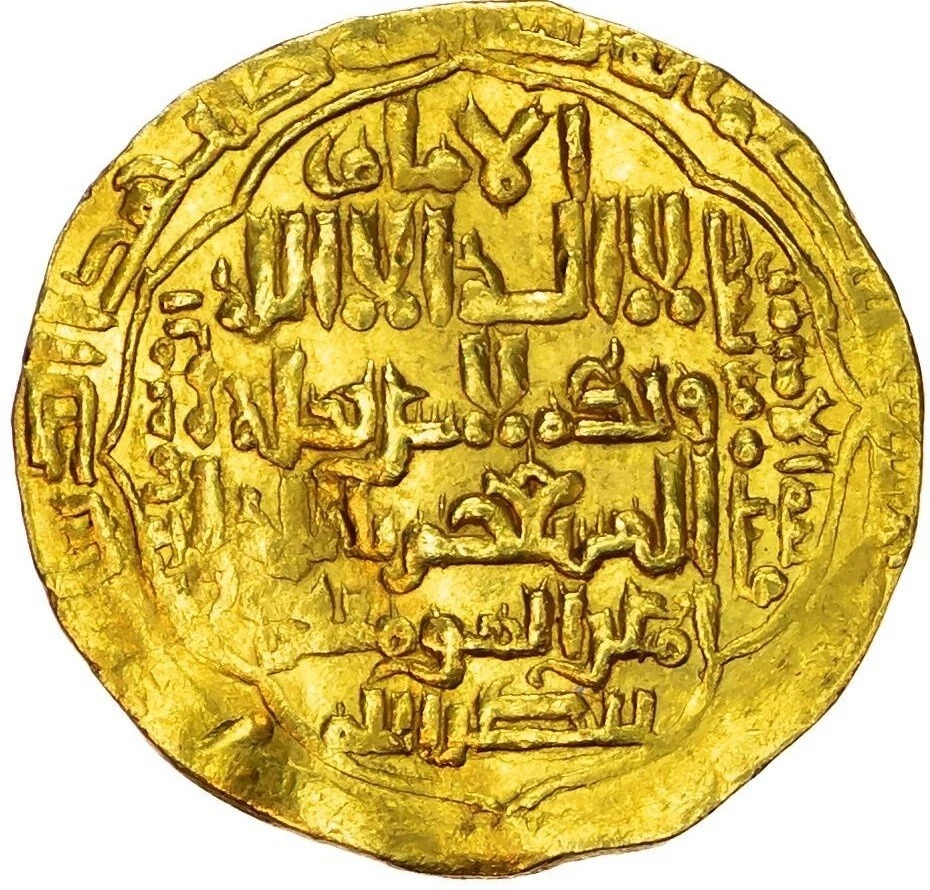
A major characteristic of Abbasid dinars is their textual structure. Rather than displaying an emperor or king, the coin communicates its identity through Arabic inscriptions.
The central religious declaration frequently includes the Shahada, affirming the oneness of God and the prophethood of Muhammad. Other inscriptions may identify the caliph or invoke Quranic passages.
A typical dinar may include several essential elements:
These inscriptions are enormously important for authentication and attribution. A seemingly small difference in Arabic lettering, inscription arrangement or mint formula can distinguish one issue from another.
Abbasid coins generally use the Hijri calendar, which began in AH 1 (622 AD). Therefore, a date such as 200 AH corresponds approximately to 815–816 AD.
However, conversion between Hijri and Gregorian dates should be treated as approximate because the Islamic calendar is lunar while the Gregorian calendar is solar. Specialist catalogues normally preserve the original Hijri date and provide the corresponding AD range.
For collectors and investors of historic coins, the date can be one of the most important pieces of information on the entire coin. It establishes the chronological context and may identify a particularly significant reign or historical event.
Abbasid gold coinage spans centuries and includes issues associated with numerous caliphs. Among the most historically important are:
Abu al-Abbas al-Saffah (132–136 AH / 750–754 AD) was the first Abbasid caliph. His brief reign belongs to the formative period of the dynasty.
Al-Mansur (136–158 AH / 754–775 AD) consolidated Abbasid power and founded Baghdad. Gold coins from his reign are particularly important for understanding the establishment of Abbasid monetary authority.
Al-Mahdi (158–169 AH / 775–785 AD) presided over a period of considerable prosperity and administrative development.
Harun al-Rashid (170–193 AH / 786–809 AD) became perhaps the most famous Abbasid caliph in popular culture. His reign is associated with the height of Abbasid political and cultural influence.
Al-Ma’mun (198–218 AH / 813–833 AD) ruled during an extraordinary period of intellectual development and political transformation. His reign is especially important to Islamic numismatics because of changes in coin inscriptions and the political circumstances surrounding his accession.
Later Abbasid gold coinage continued through successive caliphs, although the political authority of the caliphate gradually weakened and regional dynasties increasingly exercised independent power.
The mint is one of the most important identifying features of an Abbasid gold dinar.
Major Islamic mints included Madinat al-Salam, the name frequently associated with Baghdad; al-Muhammadiyah, associated with Rayy; Misr, referring to Egypt; Wasit; Damascus; and numerous other locations.
Mint names can dramatically increase a coin’s historical significance. A dinar struck at Baghdad, for example, connects the physical object directly to the great Abbasid capital. A coin from an unusual or scarce mint may be considerably more difficult to obtain than a common issue from a major production center.
The challenge is that mint names can sometimes be abbreviated, stylized or positioned in ways that are difficult for inexperienced readers to recognize. Specialist references and comparison with known examples are therefore essential.
The classical Islamic gold dinar was based on a remarkably stable monetary tradition. Many Abbasid dinars contain a high proportion of gold, although actual fineness can vary according to period, mint and issue.
A coin’s weight alone cannot establish authenticity. Ancient and medieval coins can lose weight through circulation, clipping, corrosion, cleaning or damage. Conversely, modern reproductions can be manufactured to approximate historical specifications.
Professional authentication therefore considers multiple characteristics simultaneously:
Weight, diameter, metal composition, die style, calligraphy, fabric, strike, edge characteristics, surface texture, wear and provenance all contribute to the assessment.
For particularly valuable Abbasid dinars, scientific testing such as X-ray fluorescence analysis may also be used, although interpretation requires expertise because surface composition does not always perfectly represent the underlying metal.
The importance of Abbasid dinars extends far beyond their monetary value.
They provide direct evidence of the political structure of the medieval Islamic world. The name of a caliph on a coin represents an official assertion of authority. A mint name identifies where state-controlled currency was produced. A date establishes when the coin entered circulation.
The coins also reveal the extraordinary reach of medieval commerce. Gold dinars travelled across political borders and commercial networks linking the Islamic Middle East with North Africa, Central Asia, the Mediterranean and beyond.
Their inscriptions further demonstrate the distinctive intellectual and religious environment of Islamic civilization, in which written language became the principal visual expression of political authority on money.
Rarity varies enormously.
Some Abbasid dinars survive in relatively significant numbers, while others are exceptionally scarce. Rarity may depend on the ruler, date, mint, inscription variety, historical circumstances, surviving population and condition.
An unusual mint can be more important than a famous ruler. Likewise, an early Abbasid dinar in exceptional preservation may command greater interest than a later and more frequently encountered issue.
The word rare should therefore be used carefully. A coin should ideally be described as rare because of identifiable numismatic characteristics rather than simply because it is old.
Condition is another major factor in the desirability of Abbasid gold dinars.
Because gold does not oxidize like silver or copper, ancient gold coins can survive remarkably well. Nevertheless, centuries of circulation can produce significant wear. Details in the Arabic inscriptions may become softer, while scratches, edge damage, clipping and deposits can affect the overall appearance.
Importantly, cleaning can reduce a coin’s appeal and potentially damage its original surfaces. Historic coins are generally best preserved with minimal intervention.
The popularity of Abbasid gold dinars has inevitably created a market for modern reproductions and forgeries.
A genuine coin should be evaluated through its complete physical and historical profile. Experts examine the relationship between the dies, flan, inscriptions, weight, metal and manufacturing technology.
Provenance can provide additional confidence. A documented history of ownership, previous auction appearances, reputable dealer records or established institutional references can be highly valuable.
No single characteristic—including weight, magnetism, colour or a photograph—should be treated as definitive proof of authenticity.
For significant acquisitions, independent examination by a qualified Islamic numismatist or established specialist is advisable.
Today, Abbasid gold dinars occupy a fascinating position at the intersection of history, art, archaeology and tangible assets.
Unlike modern currency, each surviving medieval dinar is an individual historical object. Its value may reflect its gold content, but its historical importance, rarity, condition, provenance and numismatic significance can be considerably more important.
For investors in historic treasures, this distinction is essential. The monetary value of the gold is only one component of the object’s overall significance.
An Abbasid dinar may have circulated more than a millennium ago, passed through the hands of merchants and officials, crossed political boundaries and survived the rise and fall of dynasties. Holding such an object today creates a direct physical connection with a civilization that shaped the history of the Middle East and the wider world.
The Abbasid Gold Dinar is far more than an ancient gold coin. It is a miniature historical record of the Abbasid Caliphate, carrying within its inscriptions evidence of rulers, dates, mints, religious identity and monetary authority.
From the revolutionary establishment of Abbasid power in 132 AH (750 AD) to the later centuries of the caliphate, these dinars document the evolution of one of medieval history’s greatest political and cultural civilizations.
For anyone seeking to understand Islamic numismatics, the Abbasid gold dinar is an essential subject. Its combination of precious metal, sophisticated calligraphy, historical documentation and remarkable survival makes it one of the most compelling forms of medieval Islamic monetary heritage.
House of Emirates® — London — Where Eternity Becomes Luxury Asset.