House of Emirates® presents this guide to one of the more technical—and frequently misunderstood—terms in numismatics: Die Axis Explained. Understanding the term helps collectors see how manufacturers made coins.
Yet there is an important distinction that every serious collector should understand:
Die axis is primarily a characteristic of coin production and attribution, not a measurement of coin condition or grade.
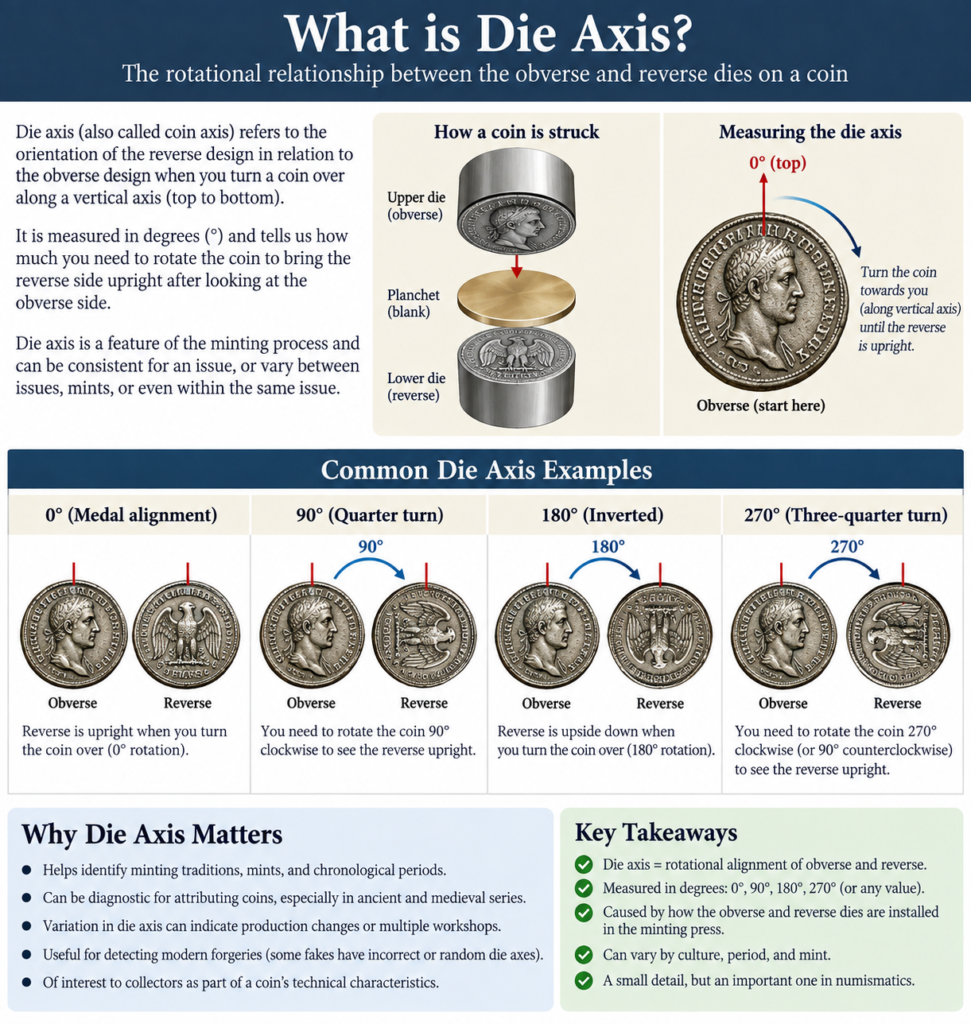
Die Axis describes the rotational relationship between the obverse and reverse dies.
Sometimes it’s called coin axis and helps illustrate how a coin is struck.
To determine the die axis, the collector holds the coin with the obverse facing upright and then turns the coin around its vertical axis—rather than flipping it over—to observe the orientation of the reverse.
We present the resulting rotation in degrees:
0° – The reverse is upright relative to the obverse, commonly called medal alignment.
90° – The reverse is rotated one-quarter turn.
180° – The reverse is completely inverted relative to the obverse, commonly associated with coin alignment.
270° – The reverse is rotated three-quarters of a turn.
Of course, die axis is not limited to these four positions. A coin may have virtually any measured orientation, depending on the minting process and how the dies were positioned.
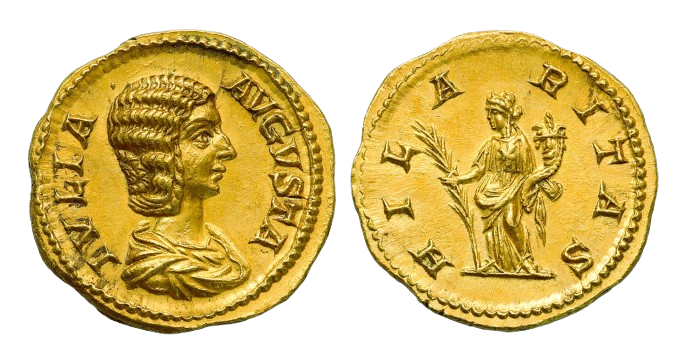
The die axis originates from the physical positioning of the obverse and reverse dies during the striking process.
In ancient and medieval coin production, particularly with hand-struck coins, the two dies were not necessarily locked into a standardized rotational relationship. Consequently, considerable variation in die axis can occur.
Modern minting technology generally allows much greater control over die orientation, although historical minting practices varied enormously between civilizations, mints, periods, and denominations.
This makes die axis potentially useful evidence when studying minting technology, production methods, individual mints, coin issues, and chronological patterns.
For the specialist Coin collector, die axis can be an additional diagnostic characteristic.
When studying an ancient or medieval coin, specialists may compare its die axis with other examples alongside:
In some coin series, recurring die-axis patterns may provide useful information about production practices or particular minting traditions.
However, die axis should never be treated as conclusive evidence on its own. A particular die axis does not automatically establish a coin’s mint, date, ruler, authenticity, or attribution.
It is one piece of a much larger numismatic puzzle.
This is perhaps the most important point for collectors.
Die axis is generally not a significant factor in determining the physical grade of a coin.
Coin grading is fundamentally concerned with the condition and preservation of the individual specimen. Depending on the coin, grading considerations can include:
Die axis measures something completely different.
It tells us how the dies were oriented, not how well the resulting coin has been preserved.
For example, imagine two identical ancient gold coins. Coin A has a 0° die axis but significant wear and surface damage. Coin B has a 180° die axis but exceptionally sharp detail and well-preserved surfaces.
The fact that Coin A has a conventional die axis does not make it a better-grade coin. Likewise, Coin B does not deserve a lower grade simply because its reverse is oriented differently.
A die-axis orientation is not a form of wear, damage, or deterioration.
Another common misconception is confusing die axis with strike quality.
These are separate characteristics.
A coin may have an unusual die axis and still be beautifully struck, with excellent detail and strong metal flow. Conversely, a coin with a conventional die axis can have a weak strike, incomplete legends, flat design elements, or uneven detail.
Therefore, an unusual die axis should not automatically be interpreted as a defect.
Usually, not directly.
For most Coins collectors, the value of a coin is driven primarily by factors such as rarity, historical importance, authenticity, condition, grade, eye appeal, provenance, demand, metal, and scarcity.
However, die axis can have specialized numismatic importance. In a particular series where die-axis patterns are well documented, an unusual or characteristic alignment may contribute to scholarly interest or help establish a coin’s relationship to a particular issue.
In such circumstances, die axis may indirectly contribute to a coin’s desirability—but this is very different from saying that a particular axis automatically increases its grade.
Die axis can be especially interesting when examining ancient and Islamic coins, where minting techniques varied substantially across different periods and regions.
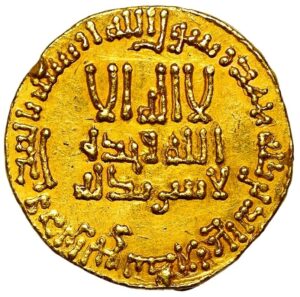
For collectors of Islamic gold dinars, Fatimid dinars, Umayyad and Abbasid coinage, medieval Islamic silver coins, Roman aurei, Greek coinage, and other historical issues, die axis can form part of a detailed technical description.
For serious numismatists, documenting the axis alongside weight, diameter, die characteristics, inscriptions, metal, and condition creates a much more complete record of the individual specimen.
The most accurate way to understand die axis is therefore simple:
Die axis tells you about the relationship between the dies. Grade tells you about the condition of the coin.
They answer two completely different questions.
A collector should certainly observe and record the die axis—particularly when dealing with ancient, medieval, rare, or academically important coins. But it should not be confused with the factors that determine preservation and condition.
Ultimately, die axis is a fascinating window into the technology and practices of historical minting. It can assist attribution, die studies, authenticity research, and scholarly analysis, but in most circumstances it should have little or no direct influence on the numerical grade assigned to a coin.
For collectors, dealers, and investors, understanding this distinction is essential: an unusual die axis does not make a coin damaged, and a perfect die axis does not make a coin well preserved.
That is the key to understanding the true numismatic significance of die axis.