For more than six centuries, the coins of the Ottoman Empire travelled through the markets of Europe, the trading ports of the Mediterranean, the commercial centres of the Middle East and the cities of North Africa. Struck in gold, silver and copper, these remarkable objects were far more than instruments of payment: they represented imperial authority, facilitated international commerce and connected communities across three continents. Their historical footprint extends far beyond the borders of modern Türkiye, reaching territories that today belong to dozens of independent countries.
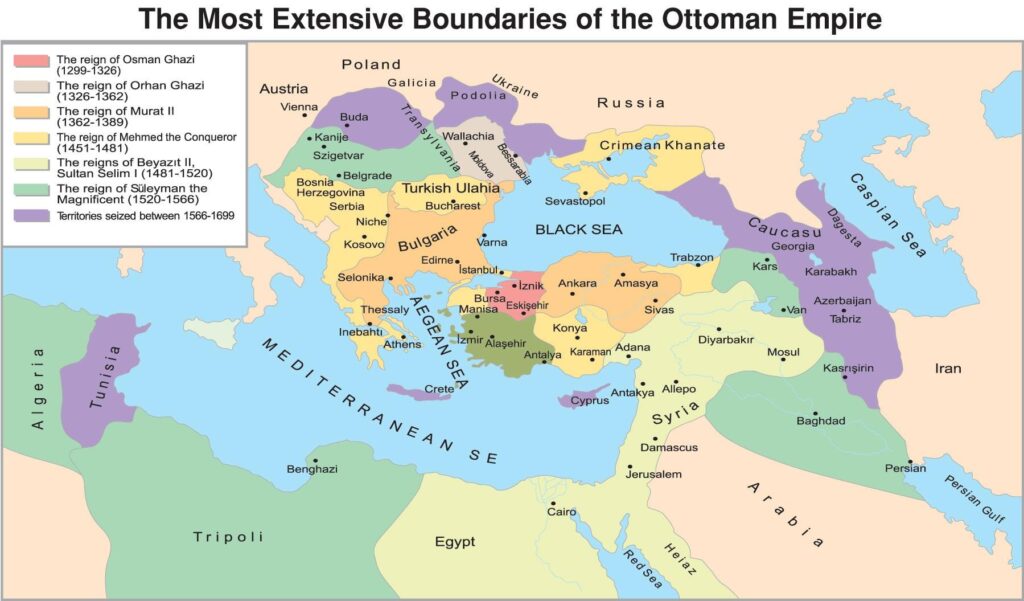
The Ottoman Empire emerged in northwestern Anatolia around the end of the thirteenth century and gradually developed into one of the most geographically extensive states in world history. At its height, it controlled territories across southeastern Europe, western Asia and North Africa. As its armies advanced, its administration expanded and its commercial networks flourished, Ottoman monetary traditions became embedded in the economic life of an extraordinary variety of regions. The result was a numismatic legacy that cannot accurately be described as exclusively Turkish.
The expression “nearly 40 modern-day countries” captures the remarkable geographical breadth of the Ottoman historical world, although it requires careful interpretation. The empire did not control every territory for the same length of time, and the presence of an Ottoman coin in a modern country does not automatically prove that the coin circulated there under Ottoman sovereignty. Some regions experienced centuries of imperial rule, others were governed for shorter periods, and coins also travelled through trade, migration and military campaigns. Nevertheless, the historical reach of Ottoman coinage offers compelling evidence of a monetary heritage shared across modern national boundaries.
The foundations of Ottoman coinage were established during the early expansion of the Ottoman principality. The earliest Ottoman silver coins, associated with the reign of Osman I and his successors, marked the emergence of an independent monetary identity. Under Orhan, the second major ruler of the dynasty, silver akçe coinage became an important instrument of administration and exchange.
The akçe would remain one of the defining denominations of Ottoman monetary history for centuries. Its significance extended beyond everyday transactions. Coin inscriptions identified rulers and communicated political legitimacy, while minting demonstrated the state’s ability to produce recognised money. As Ottoman power expanded into the Balkans, the circulation and production of its coinage followed the growth of the imperial administration.
The conquest of Constantinople in 1453 under Sultan Mehmed II transformed the empire’s political and economic position. The city, subsequently known as Istanbul, became the principal imperial capital and a central hub linking European, Mediterranean and Asian markets. Mehmed II also established Ottoman gold coinage, including the sultani, in the later fifteenth century. This strengthened the empire’s ability to support high-value transactions and participate in international commerce.
During the sixteenth century, the Ottoman Empire reached an extraordinary level of political influence. Under Suleiman the Magnificent, its territories extended across much of southeastern Europe, the Middle East and North Africa. Ottoman monetary production and commercial exchange became increasingly interconnected with regional economies, while the empire’s principal cities served as gateways between continents.
These developments established the essential character of Ottoman coinage: it was the currency of a growing imperial state whose economic life extended far beyond the geographical limits of modern Türkiye.


Ottoman monetary history was never static. Its denominations, metal standards and minting practices evolved in response to changing political circumstances, commercial requirements and the availability of precious metals.
The akçe, a small silver coin, was fundamental to the early Ottoman economy. Its circulation expanded as the empire grew, connecting urban markets and provincial communities. According to the official history of Türkiye’s General Directorate of the Mint, Ottoman akçe production initially centred on places such as Bursa and Edirne before expanding into numerous commercial and administrative centres. By the reign of Mehmed II, akçes were being struck at numerous mints.
The sultani, introduced in the late fifteenth century, represented a different level of monetary ambition. Gold coinage supported larger transactions and helped the Ottoman state participate in the international economy alongside other major trading powers. Its historical importance is inseparable from the commercial networks that linked Istanbul to the Mediterranean and beyond.
Copper coinage, including the mangır, served smaller transactions, although its production and use changed over time. Later, the kuruş became an increasingly important denomination. Its emergence reflected the pressures of a changing monetary environment in which the Ottoman state sought to maintain its own currency while responding to the widespread circulation of foreign silver.
This last development reveals a crucial aspect of the empire’s economic history. Ottoman markets were not sealed monetary systems. European coins, including Spanish silver and other internationally traded issues, could circulate alongside Ottoman money. Historical research published by Cambridge University Press documents how foreign currencies became important in Ottoman Istanbul during the seventeenth century, demonstrating that monetary influence travelled in both directions.
The geographical significance of Ottoman coins becomes clearer when the empire’s historical territories are compared with today’s political map. Ottoman rule extended across much of the Balkans, the eastern Mediterranean, Mesopotamia and North Africa, while Ottoman authority and influence also reached parts of the Caucasus and the Arabian Peninsula.
The following list illustrates the breadth of the historical geography associated with the Ottoman Empire. It is not a claim that Ottoman coins circulated uniformly throughout every territory, nor that all the countries listed experienced the same degree or duration of Ottoman control.
| Historical region | Modern-day countries and territories |
|---|---|
| Anatolia and the Caucasus | Türkiye, Georgia, Armenia, Azerbaijan |
| Balkans and southeastern Europe | Greece, Bulgaria, Serbia, Bosnia and Herzegovina, Albania, Kosovo, North Macedonia, Montenegro, Romania, Moldova, Croatia, Slovenia, Hungary, Slovakia and Ukraine |
| Eastern Mediterranean and Levant | Syria, Lebanon, Palestine, Jordan and Cyprus |
| Mesopotamia and the Arabian Peninsula | Iraq, Saudi Arabia, Yemen, Kuwait, Qatar, Bahrain, the United Arab Emirates and Oman |
| North Africa | Egypt, Libya, Tunisia and Algeria |
This illustrative grouping includes more than 35 modern states or territories, depending on how historical frontiers and disputed sovereignty are counted. It should not be presented as a definitive archaeological inventory of countries where Ottoman coins have been found. Rather, it demonstrates why Ottoman monetary history must be studied through a wider geographical lens than modern Turkish borders alone.
The distinctions between these territories matter. Greece and Bulgaria experienced extended periods of Ottoman administration. Egypt became a major Ottoman province after the conquest of 1517, while Tunisia and Algeria developed distinctive political and monetary histories under varying forms of Ottoman authority. In parts of Hungary, Ottoman rule was substantial but contested and ultimately temporary. In the Caucasus and around the Black Sea, imperial frontiers shifted through wars and treaties involving neighbouring powers.
The Arabian Peninsula presents further complexity. Ottoman authority varied considerably between the holy cities, coastal settlements, interior regions and local political authorities. Some territories were directly administered, others enjoyed substantial autonomy, and others experienced only intermittent Ottoman control or influence.
These differences do not weaken the argument for a transnational Ottoman numismatic heritage. They make it more precise. The empire was a changing political formation, and its coins must be interpreted in the context of the particular period and location to which each object belongs.
The movement of Ottoman coins resulted from overlapping networks of commerce, government, taxation, military activity and human migration.
Trade was one of the most powerful forces. Istanbul connected the Black Sea with the Mediterranean, while Cairo, Aleppo and Baghdad served as important commercial centres linking different parts of the imperial economy. Merchants transported money alongside textiles, grain, metals, spices and other commodities. Coins could pass from one market to another as payments were made, debts settled and goods purchased.
Military campaigns and government administration created additional channels of circulation. Soldiers received payments, officials collected revenues, and state expenditure redistributed money between provincial and central institutions. Campaigns and garrisons could carry coins into frontier regions, although the presence of a coin in a particular place does not by itself establish the precise circumstances of its arrival.
Pilgrimage and regional travel also contributed to monetary movement. Routes connecting Aleppo and Cairo to the holy cities brought together pilgrims, merchants and officials from different parts of the Islamic world. Such movement helped link local economies across distances that modern national borders now divide.
Finally, international currency exchange ensured that Ottoman monetary history was not a one-way story of imperial coins spreading outward. Foreign gold and silver entered Ottoman markets, and imported coins could be accepted in transactions, used in fiscal payments or melted down to provide metal for new issues. A study of Ottoman mint records for 1766–1802, published in the Journal of Turkish Cultural Studies, documents the importance of foreign coins as a source of silver for the imperial mint.
This evidence illustrates a broader historical principle: money follows economic relationships, not merely political borders. A coin might be minted in one province, spent in another, carried abroad by a merchant and eventually deposited far from its place of origin.
Ottoman coins are among the most valuable physical sources for reconstructing the history of the empire. Their inscriptions, mint marks, denominations and metal composition can help establish when and where they were produced and illuminate the political and economic circumstances of their time.
The name of a mint is particularly significant. A coin struck in Damascus, Baghdad or a Balkan city provides evidence of monetary production in that location. When examined alongside historical records and archaeological evidence, such coins help researchers reconstruct the reach of imperial administration and the movement of money.
Yet numismatists must distinguish between the place where a coin was minted and the place where it was subsequently used. A coin found in modern Romania, for example, may reflect Ottoman rule, cross-border commerce, military activity or later movement. Its historical meaning depends on its date, provenance and archaeological context.
Ottoman coins also reveal the diversity of the empire. Their changing denominations and monetary standards reflect an administration that governed communities with different commercial traditions, languages and religious backgrounds. They embody not only the authority of individual sultans but also the daily economic interactions of people whose lives extended across regional boundaries.
The Ottoman Empire came to an end in the aftermath of the First World War, and the Republic of Türkiye was established in 1923. The political map changed dramatically, but the empire’s material heritage survived. Coins remained in circulation for varying periods, entered private collections, appeared in archaeological deposits and passed between generations as historical objects.
Their legacy is consequently shared by many countries whose present-day borders did not exist in their modern form during the Ottoman centuries. To study Ottoman coinage solely as Turkish national heritage would overlook the histories of the Balkan cities where coins were struck, the North African provinces that developed their own monetary practices and the Middle Eastern trading centres that connected the empire’s markets.
For institutions such as House of Emirates®, presenting Ottoman coins within this wider historical context offers an opportunity to communicate their true significance. Each coin is a tangible connection to a world shaped by imperial ambition, international trade and cultural exchange.
Ottoman coins tell a story that transcends modern borders. From the silver akçe of the early Ottoman state to the gold sultani and later imperial denominations, these objects document more than six centuries of political transformation and economic exchange.
Their production expanded from the empire’s Anatolian heartland into a network of provincial and regional mints. Their circulation followed merchants, soldiers, officials and travellers across southeastern Europe, western Asia and North Africa. Their survival in modern collections and archaeological contexts preserves evidence of a historical world whose geographical connections remain visible today.
The expression “40 countries, one empire” captures the extraordinary breadth of this legacy, provided it is understood as a reference to the empire’s extensive historical geography rather than a claim of uniform coin circulation across every modern state.
Long after the empire disappeared, its coins continue to bear witness to the civilisation that produced them—and to the commercial and cultural connections that carried them far beyond the borders of modern Türkiye.