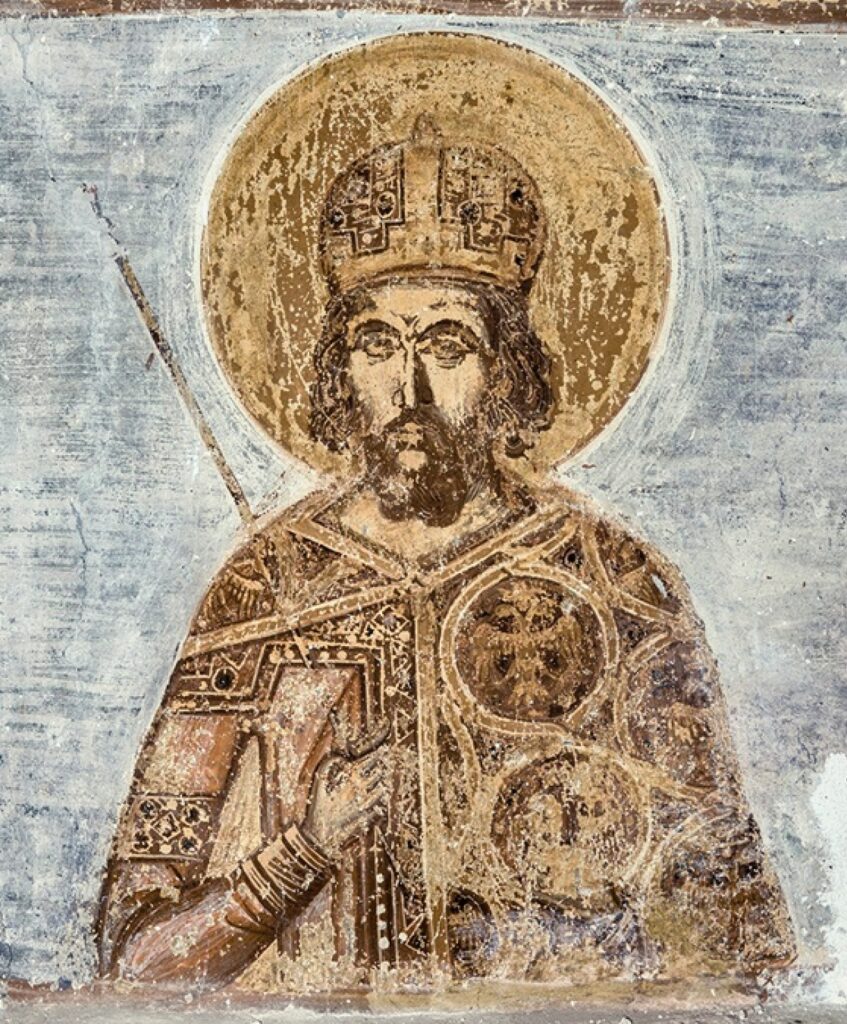
By: House of Emirates Luxury Coins
The death of Constantine XI Palaiologos, the Last Byzantine Emperor, remains one of the most intriguing mysteries of all times. It surrounds the fall of the city on 29 May 1453.
Unlike many rulers of the medieval world, Constantine left behind no securely identified tomb. There is no universally accepted eyewitness account of his final moments. No indisputable physical remains exist.
We know that he was present at the final breach. He chose to fight rather than abandon Constantinople.
What we do not know with absolute certainty is precisely how he died. Or what happened to his body.
From this uncertainty emerged five principal theories.
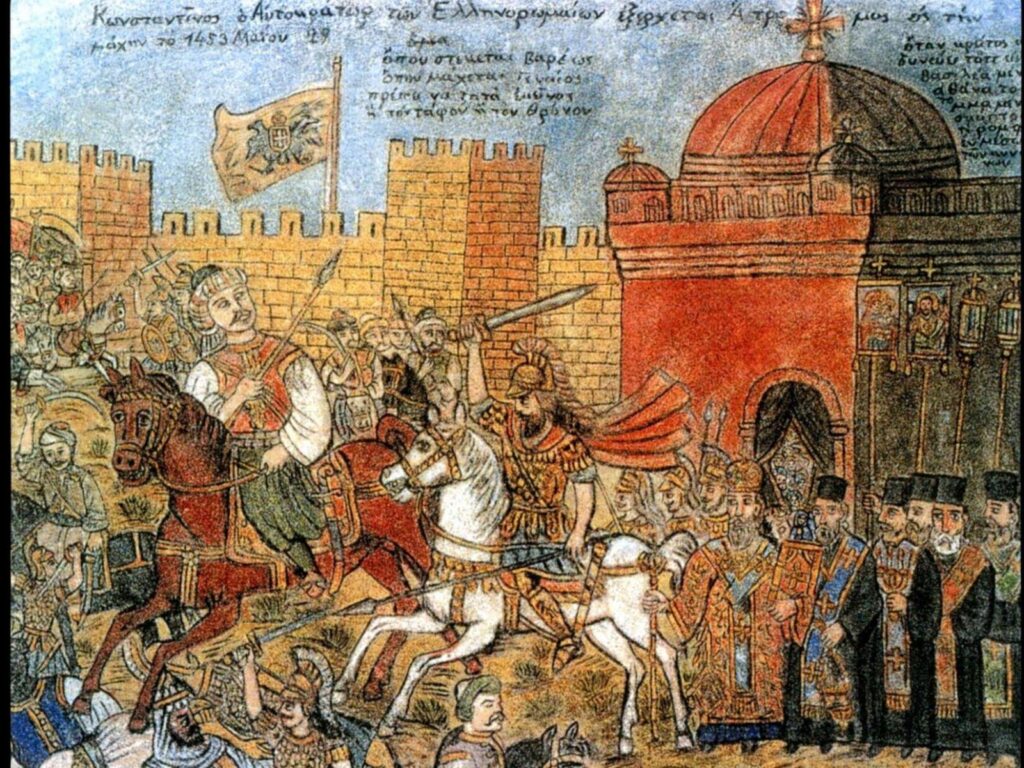
This is by far the most historically credible explanation. Constantine spent the final hours of the siege at the most threatened section of the land walls, around the Gate of St. Romans, where the Ottoman assault ultimately broke through. Several traditions place his final stand there. An Ottoman historical tradition preserved by the Ottoman Historians project similarly places Constantine at the Gate of St. Romans and reports, albeit from hearsay, that he died fighting there.
The strongest version of this theory comes from accounts portraying Constantine as deliberately removing his imperial insignia and entering the mêlée as an ordinary soldier. This would explain why his body could subsequently have been difficult to identify. If he had indeed stripped away his purple garments and imperial symbols, the Ottomans would have encountered a heavily armed Byzantine warrior among thousands of corpses rather than an immediately recognizable emperor.
A second theory, particularly prominent in Ottoman sources, is that Constantine was killed during an attempt to fight his way through the collapsing defenses and that his head was subsequently severed. The Ottoman chronicler Tursun Beg gives a considerably less heroic version of events, describing Constantine as attempting to reach the harbor before encountering Ottoman troops. Other Ottoman traditions similarly associate his death with decapitation.
This theory deserves serious consideration because the Ottomans had an obvious political reason to establish that the emperor was dead. Sultan Mehmed II had conquered the Roman imperial capital and assumed the title of Caesar of Rome. The death of Constantine was therefore politically significant. Yet Ottoman accounts written after the conquest are not necessarily eyewitness testimony, and they contain contradictions. Consequently, historians cannot confidently reconstruct the exact sequence.
Perhaps the most fascinating possibility is that Constantine really did die in the fighting, but his body simply disappeared among the dead. The final battle was extraordinarily chaotic. Thousands of defenders and attackers were fighting in confined spaces, while the city was simultaneously being entered by Ottoman troops and subjected to widespread violence and looting.
One contemporary-style tradition says that a search was made for Constantine after the fighting, but identifying him proved problematic. Later accounts claim that a body was found and that the emperor’s head was displayed, but these reports cannot be independently verified. Modern historians therefore distinguish between the certainty of Constantine’s death and the uncertainty surrounding his remains.
This distinction is important. The absence of a confirmed tomb does not constitute evidence that he escaped. In fact, the lack of identifiable remains is entirely compatible with death on the battlefield.
The fourth theory is the one that has fascinated generations of historians, storytellers and treasure hunters: Constantine survived the fall of Constantinople and escaped disguised as an ordinary soldier or civilian.
There was enough confusion on 29 May for individuals to escape the city by ships, through breaches, and by disguising themselves. We know that numerous Byzantines and Westerners successfully escaped the massacre and captivity.
There were also later traditions claiming that Constantine’s body could not be found because he had escaped. Some versions placed him among refugees leaving the city; others transformed the story into something supernatural. However, there is a fundamental problem: no contemporary reliable source provides evidence that Constantine actually reached safety. The escape theory therefore remains possible in the narrow sense that the evidence cannot reconstruct every minute of his final movements, but historically it is extremely weak.
The fifth theory is not really historical, but it is perhaps the most beautiful and enduring. According to the Greek tradition of the “Marble Emperor,” Constantine did not truly die. At the moment the Ottomans were about to kill him, an angel supposedly intervened, transformed him into marble and concealed him beneath Constantinople. There he sleeps, waiting for the divinely appointed moment when he will awaken, reclaim the city and restore the Roman Empire.
This legend emerged after 1453 and transformed Constantine from a defeated emperor into an immortal symbol of the lost Roman world. The story became particularly powerful because Constantinople itself had survived countless sieges for more than a thousand years. The idea that its final emperor was merely sleeping beneath its walls offered hope that the city’s Christian Roman destiny had not truly ended.
Modern scholarship does not regard the Marble Emperor story as historical evidence. Yet it tells us something profound about how Greeks understood the catastrophe of 1453: Constantine could die, but the idea of the Roman emperor could not.
Of the five theories, the first three are variations of the same basic historical conclusion.
The Last Byzantine Emperor, Constantine XI, died during the final fighting, probably near the Gate of St. Romans.
The exact circumstances and fate of his body remain uncertain.
The escape theory has no sufficiently reliable evidence behind it.
The Marble Emperor belongs firmly to the realm of national and religious legend.
The mystery nevertheless remains unusually compelling. Even the modern scholarship surrounding the fall recognizes that there is no precise eyewitness reconstruction of Constantine’s final seconds. One modern historical discussion notes explicitly that we possess no precise information about how he met his end, while the traditions place him in the St. Romans sector.
Perhaps this uncertainty explains why Constantine XI became more than merely the last emperor of Byzantium. He became the last Roman emperor whose body was lost, whose death was never completely witnessed, and whose legend therefore outlived his empire. The Ottoman conquest ended the Roman Empire politically on 29 May 1453, but Constantine’s disappearance into the chaos of that morning allowed the final emperor to pass from history into legend — where, according to the Greeks, he still waits beneath the stones of Constantinople.